Classification and Applications of Industrial Microscopes
① Measuring microscopes: for microelectronics and precision machining industries; ② Stereo microscopes: mainly for on-site inspection, widely used in PCB, liquid crystal and related industries; ③ Metallurgical microscopes: for material analysis, meeting the requirements of steel and metal processing industries.
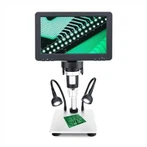
Measuring microscopes are equipped with a high-precision stage, high-accuracy digital readout measuring heads and cameras. Targeting can be performed directly on a computer screen instead of by naked-eye alignment, which reduces human error and guarantees high measurement accuracy. They are ideal versatile compact precision measuring instruments.
Measuring microscopes adopt transmitted and reflected illumination for precise measurement of workpiece lengths and angles. They are especially suitable for the electronics industry and mechanical precision machining, used to measure trace widths of electronic circuits and geometric dimensions of tiny workpieces and other precision parts. Enhanced measuring microscopes are widely deployed in metrology rooms, production lines and research laboratories.
The measuring microscope features a high-precision stage together with high-resolution digital measuring heads. It is easy to operate and highly reliable, and provides high magnification. In addition to X and Y axis translation, the stage supports 360° rotation and Z-axis height measurement. Its illumination system supports transmitted light, reflected light and oblique lighting.
Stereo microscopes, also known as dissecting microscopes, are visual instruments producing erect three-dimensional images. They are widely applied in biology, medicine, agriculture, forestry, industry and marine biology. Their features are listed below:
① The two light beams inside the binocular tubes are not parallel but intersect at a stereoscopic angle (typically 12°–15°), producing three-dimensional perception in the image;
② The image is upright for convenient manipulation and dissection, achieved by prisms below the eyepieces that invert the image;
③ Although the magnification is lower than that of conventional microscopes, they offer a long working distance;
④ Large depth of field, enabling observation of the full thickness of specimens;
⑤ Large field-of-view diameter.