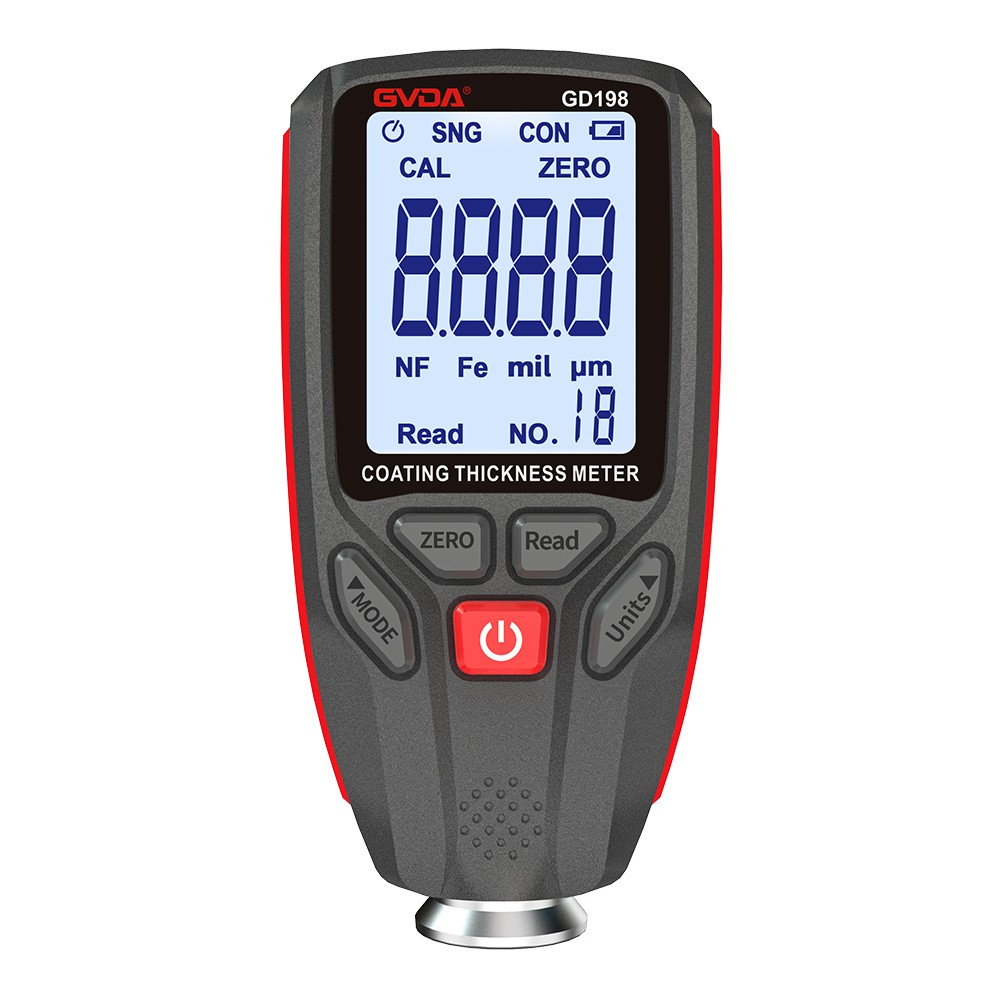
Coating thickness gauge use attention 5 matters
1. Do not use inferior batteries to avoid leakage and corrosion of the host motherboard. Once leakage is found, please send it for repair immediately. If it is too late, the host will be scrapped directly. If not used for a long time, please remove the battery.
2. When plugging or unplugging the probe, you must first turn off the power of the host before plugging or unplugging. Otherwise, it is easy to cause the integrated block inside the probe to burn.
3. When measuring, the probe should be placed stably, and the force should not be too strong, and the probe should not be touched very quickly; when testing, the probe should not be scratched back and forth on the surface to be measured, as this can easily cause damage to the probe.
4. It is very important not to measure when the coating is not dry. Many customers often measure when the coating is not dry. After the probe is stained with paint, use banana water or xylene to clean it off before use. . If you do this, the most serious probe will be scrapped directly. Even if it is not scrapped, the sensitivity of the probe will be reduced, and the service life of the probe will also be reduced.
5. When choosing a coating thickness gauge, try to choose a split-type instrument. Since the probe is a wearing part and has a certain service life, it is also a consumable. The probe of the all-in-one machine cannot be repaired, and the price of replacing the probe is very high, close to the price of a new machine. The split machine only needs to replace the probe.
Solution to reduced sensitivity of coating thickness gauge probe
Under normal circumstances, the main unit of the coating thickness gauge is not easy to break and can be used for a long time under normal use. However, the sensitivity of the probe will decrease after reaching a certain service life. Especially if you do not follow the specifications during use, it can easily cause the sensitivity of the probe to decrease. After the sensitivity of the probe is reduced, it will be impossible to zero-calibrate, and the measuring host will have no display on the zero board. There is another phenomenon that can be displayed on a zero plate with poor surface roughness, but cannot be measured on a zero plate with good surface roughness. When this happens, it means that the probe has been damaged, but it can still be used. There are two ways to solve the problem after the probe sensitivity is reduced. 1. Place the probe on the edge of the zero plate for zero calibration. The middle of the zero plate cannot be measured. Under normal circumstances, the edge of the zero plate can also be measured and displayed.
2. Use a very thin diaphragm to measure to see how big the error is in the reading (take the average), then remember this error, and subtract this error every time you measure in the future to get an accurate reading.