Common Problems and Solutions of Wood Moisture Meter
Why should I use a wood moisture analyzer?
This may be a common question among first-time users of a hygrometer. Although the specific answer to this question may vary by industry, these answers are usually related to quality.
By using a wood hygrometer, you can accurately assess potential issues that a given sample of wood may encounter, such as cracking, shrinkage, splitting, mold growth, etc. When the moisture content of wood is too high (or even too low, in some cases), the quality of the final product will be affected.
Using a hygrometer can help you ensure that the moisture content of the wood material used is within the correct% MC range to avoid future fluctuations.
What are the different types of wood moisture meters?
Although there are countless hygrometer models on the market and new hygrometers are constantly emerging, they can be divided into two categories based on their operation:
Needle spacing.
Needle free rice.
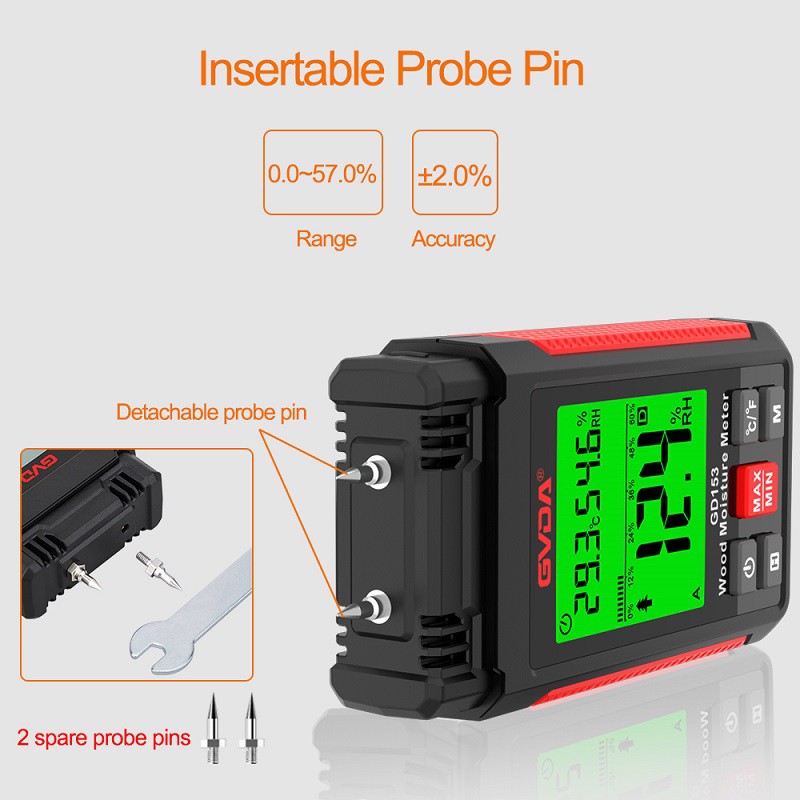
A needle hygrometer uses two (or more) electrodes to penetrate wooden materials and read the% MC of the material using the principle of resistance. In a two needle instrument, one pin emits current and the other pin receives current, and the instrument interprets the impedance of the current to the current. Due to wood being an insulator and water being a conductor, the lower the resistance of electric current, the higher the moisture content of wood.
On the other hand, the needle free electricity meter uses electromagnetic radio waves to scan the wood samples under the instrument panel. These instruments are sometimes referred to as non-invasive hygrometers because they do not have to physically penetrate the surface of wood to obtain readings
Which type of moisture analyzer is better?
After inquiring about different types of moisture meters, most people still want to know which type of moisture meter is a good one. The answer largely depends on the type of work you are doing, the size of the wooden material you are using, whether there are pinholes left in the material, and your personal preferences.
Needle free instruments have fast speed and will not damage the surface of the scanned material. On the other hand, needles can provide you with more specific information about the distribution of moisture in wood.
Many professionals use two types of instruments in their work and switch between them when necessary.
Will temperature affect the accuracy of instrument readings?
The common questions and answers of the wood moisture analyzer are shown in Figure 3. The short answer is yes, but usually the degree is very small in needle instruments. As the temperature of the wood increases, its resistance decreases, resulting in an increase in the indicated% MC of the sample. For on-site conditions, if the temperature of the tested wood sample is between 50 ° F (10 ° C) and 90 ° F (32.2 ° C), there is no need to calibrate the temperature reading results.
When measuring wood materials beyond these temperature values and the instrument itself does not have built-in temperature calibration, you can use a temperature calibration chart to find the calibration (Delmhorst provides these calibrations for each hygrometer).
Needle free measuring instruments do not measure resistance, so their readings are not affected by the temperature of the wood unless the sample is completely frozen.