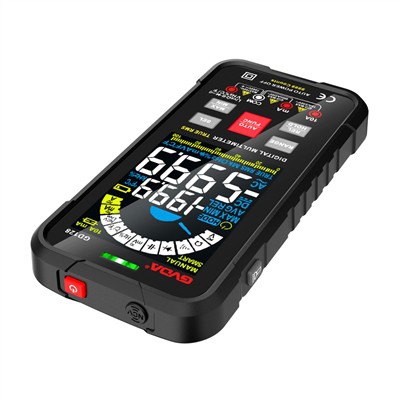
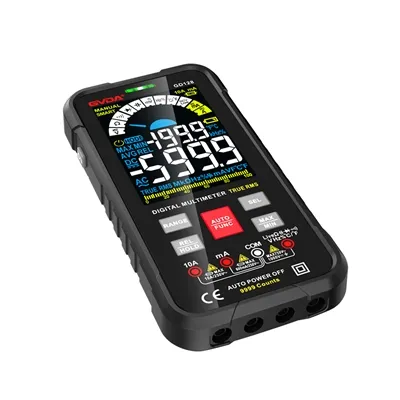
Comparison Between Analog and Digital Multimeters in Practical Use
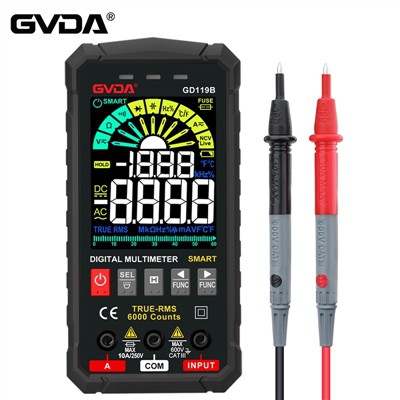
Analog multimeters have relatively poor reading accuracy, but the swinging movement of the pointer is highly intuitive. Its speed and amplitude can often objectively reflect the magnitude of the measured value (such as detecting slight fluctuations on the TV data bus (SDL) during data transmission). Digital multimeters provide clear numerical readings, but the rapidly changing digits appear chaotic and are difficult to observe clearly.
Analog multimeters usually contain two batteries: one 1.5V low-voltage battery and one 9V or 15V high-voltage battery. The black test lead is positive relative to the red lead. Digital multimeters typically use a single 6V or 9V battery. In resistance mode, analog multimeters output much higher current than digital ones. The R×1Ω range can produce a clear "click" sound from a speaker, and the R×10kΩ range can even light up a light-emitting diode (LED).
In voltage mode, analog multimeters have lower input resistance and lower measurement accuracy. They may even fail to take accurate readings in high-voltage, low-current scenarios because their internal resistance affects the circuit under test (for example, measurements of the acceleration voltage of a TV CRT will be much lower than the actual value). Digital multimeters have very high input resistance in voltage mode, at least in the megaohm range, so they have little effect on the measured circuit. However, their extremely high output impedance makes them susceptible to induced voltages, and readings may be false in environments with strong electromagnetic interference.
In summary, analog multimeters are suitable for measuring high-current, high-voltage analog circuits such as TVs and audio amplifiers. Digital multimeters are better for low-voltage, low-current digital circuits such as pagers and mobile phones. This is not absolute; either type can be chosen according to actual conditions.