Comprehensive Knowledge of Ultraviolet Illuminometer
Overview of Ultraviolet Illuminometer
Ultraviolet irradiance meter, also known as ultraviolet irradiance meter, ultraviolet intensity meter, etc., mainly measures the radiation intensity of ultraviolet radiation, used for ultraviolet irradiance measurement in fields such as photochemistry, polymer material aging, flaw detection, ultraviolet light source, plant cultivation, large-scale integrated circuit lithography, etc.
The ultraviolet illuminometer uses a combination of 35 different detection heads to measure UVA, UVB, UVC, visible light, and infrared light. The measurement wavelengths of ultraviolet illuminometers are divided into UVA (320nm-380nm), UVB (280nm-320nm), and UVC (200nm-280nm). Some products can detect a wide range of wavelengths, with user-friendly operation, small and flexible, and can be operated with one hand. The probe is separated from the body, convenient and simple, and has automatic memory function. It can store 20 sets of data, and can be widely used in industries such as health, medical, chemical, hygiene, food, electronics, aerospace, etc. It is suitable for ultraviolet radiation UV irradiance measurement in fields such as physical therapy, fluorescence analysis, UV lithography, water treatment, and breeding.
The principle of ultraviolet illuminometer
Ultraviolet illuminometer is a specialized instrument for measuring luminosity and brightness. The measurement of light intensity (illuminance) is the degree to which an object is illuminated, that is, the ratio of the luminous flux obtained on the surface of the object to the illuminated area. An illuminometer is usually composed of a selenium or silicon photocell and a microampere meter. The principle is that a photocell is a photoelectric element that directly converts light energy into electrical energy. When light strikes the surface of a selenium photocell, the incident light passes through the metal film 4 and reaches the interface between the semiconductor selenium layer 2 and the metal film 4, generating a photoelectric effect at the interface. The magnitude of the potential difference generated is proportional to the illumination on the surface of the photocell receiving light. At this point, if an external circuit is connected, a current will pass through, and the current value will be indicated on the microampere meter with a scale of Lx. The magnitude of photocurrent depends on the strength of the incident light and the resistance in the circuit. The illuminometer has a shift device, so it can measure both high and low illuminance.
Structure Description of Ultraviolet Illuminometer
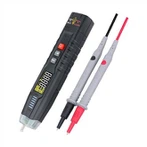
The instrument consists of an ultraviolet probe UV365 (or UV420) and a reading unit, both of which are connected through cables using plugs and sockets. The functions of each button on the left side of the reading unit are:
Power: Press this button to turn on the power, lift this button to turn off the power
Hold ": Press this button to hold the data, lift this button to sample the data. When measuring, lift this button.
UV365: Press this key when using the UV365 probe (at this point, the "UV420" key must be lifted)
UV420: Press this key when using the UV420 probe (at this point, the UV365 key must be lifted)
“ × 1 × 10 " × 100 ", and × 1000 "is a four range button
The function of the ultraviolet illuminometer
Easy to use: Simply connect a new sensor and the host will automatically configure it without the need to enter new programs and calibration factors. Setting and operation of detectors