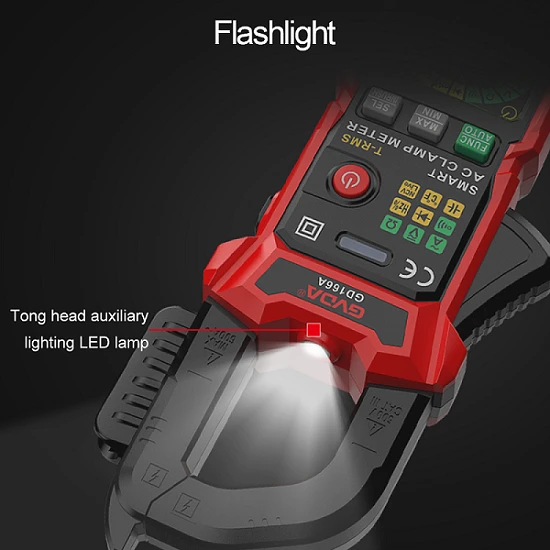
Correct use of clamp-on ammeters for AC current measurement
Clamp ammeter use, selection and pre-use checks
1. Use: It can measure the AC current on the low-voltage line without interrupting the load operation (without disconnecting the current-carrying wires). (For 50HZ 500V below)
2. Selection: its accuracy and * large range should meet the needs of the test.
3. Pre-use inspection: (1) Appearance inspection: all parts should be intact; clamp handle operation should be flexible; jaws of the iron core should be free of rust, the closure should be tight; core insulation sheath should be intact; the pointer should be able to swing freely; gear change should be flexible, the hand induction is obvious;
(2) Adjustment: lay the table flat, the pointer should point at zero, otherwise adjust to zero.
Measurement 1. Select the appropriate gear. The principles of gear selection are: (1) when the measured current range is known: choose the gear that is greater than the measured value but * close to it.
(2) do not know the measured current range: can be placed in the first current *** test (or according to the cross-section of the wire, and estimate its ** load capacity, appropriate selection of gears), according to the test situation to determine whether the need to downshift the measurement. In short, the deflection angle of the needle should be as large as possible.
2. The test person should wear gloves, the flat end of the table, open the jaws, so that the wire under test into the jaws and then close the jaws.
3. The wire under test should be located in the centre of the space part of the jaws, and the jaws should be closed tightly;
4. After measuring the large current, before measuring the small current, the jaws should be opened and closed several times for demagnetisation;
5. If the measurement of small current, in the * low gear on the measurement, the needle deflection angle is still very small (the needle deflection angle is small, means that the relative error of its measurement is large), allowing the wire in the jaws of the iron core wrapped around a few turns, close the jaws and then take a reading. The current value on the wire = reading ÷ turns (turns of the calculation: the inside of the jaws of a few lines, counted as a few turns);
6. Readings: according to the gear used in the corresponding scale readings. (Note! Gear value that is the full bias value);
7. After use, the gear should be located in the current to zero.
Safety issues to be noted in the measurement
1. Make a full check of the meter before measurement and select the gear correctly;
2. Test should wear gloves (insulated gloves or clean and dry wire gloves), if necessary, should be set up into the custody;
3. Need to change gear when measuring, should be the first wire from the jaws of the exit, change gear and then clamp into the wire measurement;
4. Can not measure the current on the bare conductor;
5. Measurement, pay attention to the nearby charged body to maintain ** distance (not less than 0.1 m, and should be careful not to cause a short circuit between phases and relative to the ground short circuit, to prevent personal electric shock;
6. It is not allowed to measure on the moving contact of the switch or the fuse;
7. After use, the gear position should be in the current ***, when there is a table set into the table set, stored in a dry, dust-free, non-corrosive gases and not subject to vibration of the place.