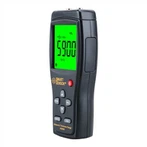
Countermeasures against the influence of infrared thermometers
Whether the electrical equipment fault is a heating fault (conductive circuit fault) caused by the current effect, the heating power is proportional to the square of the load current value. For heating faults caused by voltage effects (insulation medium faults), the heating power is proportional to the square of the operating voltage. Therefore, the operating voltage and load current of the equipment will directly affect the effect of infrared detection and fault diagnosis. The increase of the leakage current can cause the partial voltage of the high-voltage equipment to be uneven. If there is no load operation or the load is very low, the equipment failure and heating will not be obvious. Even if there is a serious failure, it is impossible to be exposed in the form of characteristic thermal abnormalities. Only when the equipment is operated at the rated voltage and the load is greater, the heat generation and temperature rise will be more serious, and the characteristic thermal anomaly of the fault point will be exposed more obviously. Therefore, when performing infrared detection, in order to obtain reliable detection results, it is necessary to ensure that the equipment operates at rated voltage and full load as much as possible. During the process, the equipment can be operated at full load for a period of time (such as 4 to 6 hours), so that the faulty parts of the equipment have sufficient heating time and ensure that the surface reaches a stable temperature rise.
Since the infrared diagnosis of electrical equipment faults, the fault judgment standard is often based on the temperature rise of the equipment at the rated current, so when the actual operating current is less than the rated current during detection, it should be the temperature rise of the equipment fault point actually measured on site. Temperature rise at rated current.