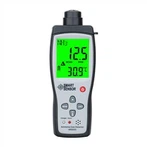
Cross-interference of gas sensors--deficiencies of gas detectors
It must be emphasized that, so far, there is no gas sensor for a certain gas* that is not effectively used for a specific gas sensor, that is to say, any gas sensor wing gas sensor. If the detection of carbon monoxide detection in the environment. For example, a signal indicating that the detection solution may also react on the sensor, from the presence of a high concentration of hydrogen, to a signal higher than the actual concentration of carbon monoxide, this is called the "crossover of the sensor". Step-optimization is through various physical or chemical methods, such as using over-speed film and different circuit parameters, so that the reaction of non-measured gas is reduced to a minimum.
On the other hand, "cross-interference" will also provide some convenience for instrument manufacturing in some cases. For example, carbon monoxide detectors can be used to detect hydrogen (of course, the premise is that there is only hydrogen and no carbon monoxide in the environment. At the same time, this sensor needs to use hydrogen to calibrate). Our common carbon dioxide/hydrogen sulfide dual sensor is also manufactured by the manufacturer by taking advantage of the mutual "cross-interference" characteristics of carbon monoxide and hydrogen sulfide sensors. purpose of the gas.
Due to technical limitations, the gas sensor must be continuously calibrated (calibration of the principle and application of toxic and harmful gas detection instruments) in order to obtain more accurate measurement results. The general technical requirement is that a "bump test" must be performed on the instrument before each use. If the measurement result of the instrument is within the error range of the instrument, the instrument can be used normally. Once the test result deviates from the normal error If it is outside the range, the instrument must be re-calibrated before it can be used.
Most sensors have their service life. Generally speaking, the life of electrochemical sensors is 2 to 3 years (the life of oxygen sensors is 1 to 2 years), catalytic combustion sensors are about 3 years, and infrared, semiconductor and photoionization sensors are about 3 years. In 3~5 years. At the same time, these parameters also have a great relationship with the use environment, and the life of the sensor will be shortened to a certain extent when it is used in an environment where the ambient concentration is continuously high or the alarm is frequent.
Therefore, if you need to obtain higher selectivity of gas detection in actual analysis, or need to know the accurate concentration data of a certain gas, you must use the method of laboratory analysis instruments. There are many analytical instruments for gas concentration measurement, such as Fourier transform infrared, gas chromatography, and mass spectrometry, all of which can provide accurate and highly selective gas concentration data. Of course, most of these devices are relatively expensive, have high maintenance costs, long response time, large volume, cumbersome operation, and cannot immediately reflect the on-site concentration, so they are not suitable for on-site gas monitoring. They are more used as laboratory gas monitoring instruments. , The data obtained through these analysis methods can serve as the final basis for judging the gas hazard results.
Nevertheless, the most mature and widely used gas sensing technology is still playing an increasingly important role in daily production safety, environmental protection, occupational protection, etc. After using analytical techniques to obtain the accurate distribution and concentration of toxic and harmful gases in the environment, the use of these on-site detection technologies can achieve the purpose of on-site rapid detection. Therefore, it can be said that it is these simple and reliable detection methods that make gas concentration detection possible. Deep into every aspect of our work and life.