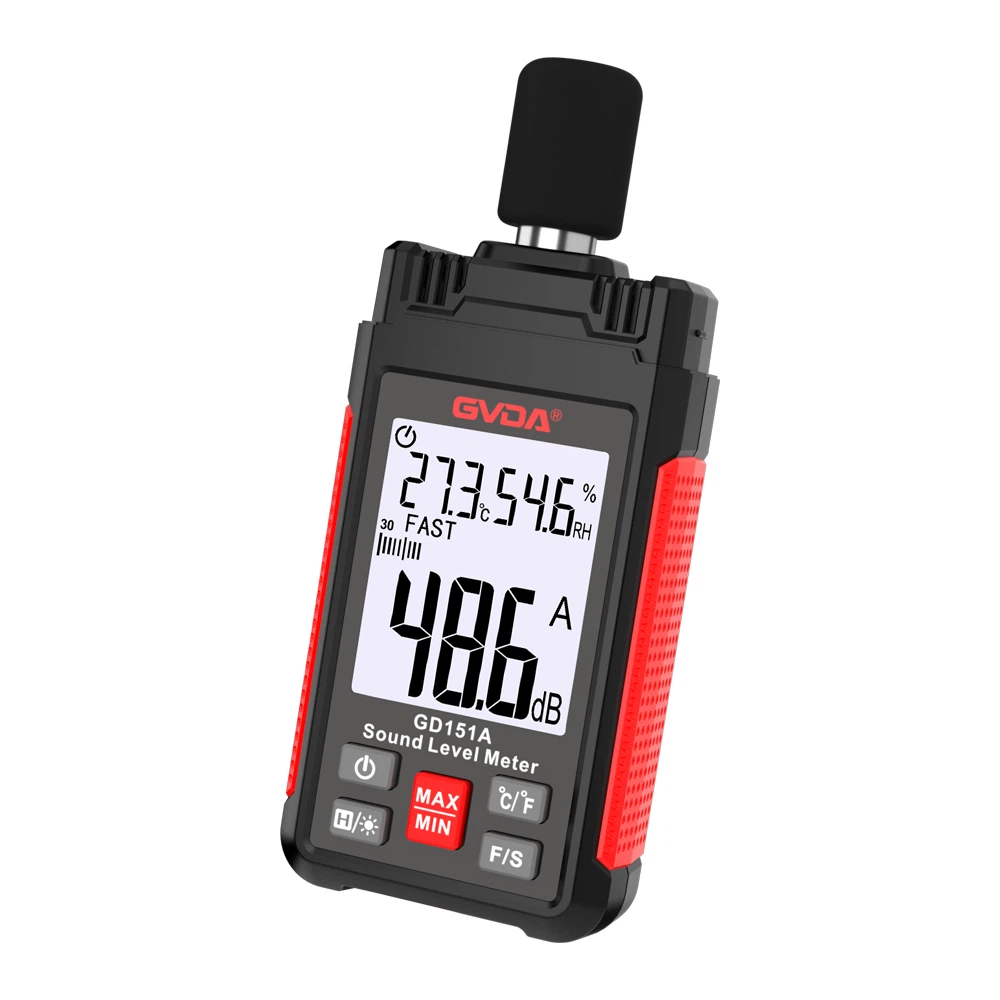
Design and Application of Sound Level Meter Based on MEMS
Designing and building an effective sound level meter requires overcoming the aforementioned shortcomings, the most important factor being ensuring that the frequency response is flat with respect to the specified theoretical weighted response (dB-A, dB-C or dB-Z). High-frequency resonance and damping of MEMS microphones vary from individual to individual, so it is important to measure the resonance accurately and optimize the correction filter to flatten the response. During production, Convergence Instruments uses adaptive filter technology to identify and optimize correction filters for each weighting factor.
The process is fully automated and takes 30 seconds per instrument. Figures 3, 4, and 5 show the error relative to the theoretical dB-C response for the uncorrected microphone and the corrected filtered microphone. There are two methods available for response correction.
Method 1: As a standard specification, the response is required to be flat from 20Hz to 10kHz. Above 10kHz, it must follow exactly the center point between the two limit lines of IEC61672-2002 Type I. This provides the best margin for meeting that standard.
Method 2: Convergence Instruments can also flatten the response down to 20kHz as a special request.
Dust is combated with an ePTFE membrane, which has an extremely small porosity to stop any dust or even liquid from entering the microphone cavity. The best ePTFE membranes for MEMS microphones have about 1db of attenuation with a slight frequency dependence, so this frequency dependence must be taken into account when performing frequency response corrections after placing the membrane in the microphone.
Damage to MEMS microphones due to static or dynamic overpressure cannot be counteracted, and this vulnerability also needs attention. MEMS microphones are designed with equalization holes in the silicon structure, but at low frequencies, the equalization time constant is long, which means that rapid changes in pressure can damage the microphone. A typical situation that causes overpressure is plugging a microphone into a calibrator. The absolute maximum pressure limit of 160dB-SPL means only 0.02 atmospheres. The absolute maximum pressure limit is reached by inserting the microphone into the calibrator, so inserting the microphone into (and removing from) the calibrator must be done as slowly as possible to allow the microphone to equalize the pressure as best as possible and avoid damage. Also note that MEMS microphones are not the best choice for measuring high-pressure sound pulses such as explosions or gunshots. In such applications, it must be ensured that the peak pressure at the measurement location does not reach the absolute maximum pressure level.
in conclusion
Because MEMS microphones are designed and manufactured for the consumer market, they are capable of acquiring high-quality signals at low cost. MEMS manufacturing technology ensures that the parameters of each microphone are highly consistent, and they are very stable over time and temperature. The high-frequency resonance of the MEMS microphone must be precisely canceled out to obtain a sufficiently accurate spectral sensitivity to meet the requirements of a Type I sound level meter, which requires advanced signal processing techniques. However, given the enormous computing power of today's processors, this does not add significantly to the cost of the instrument.