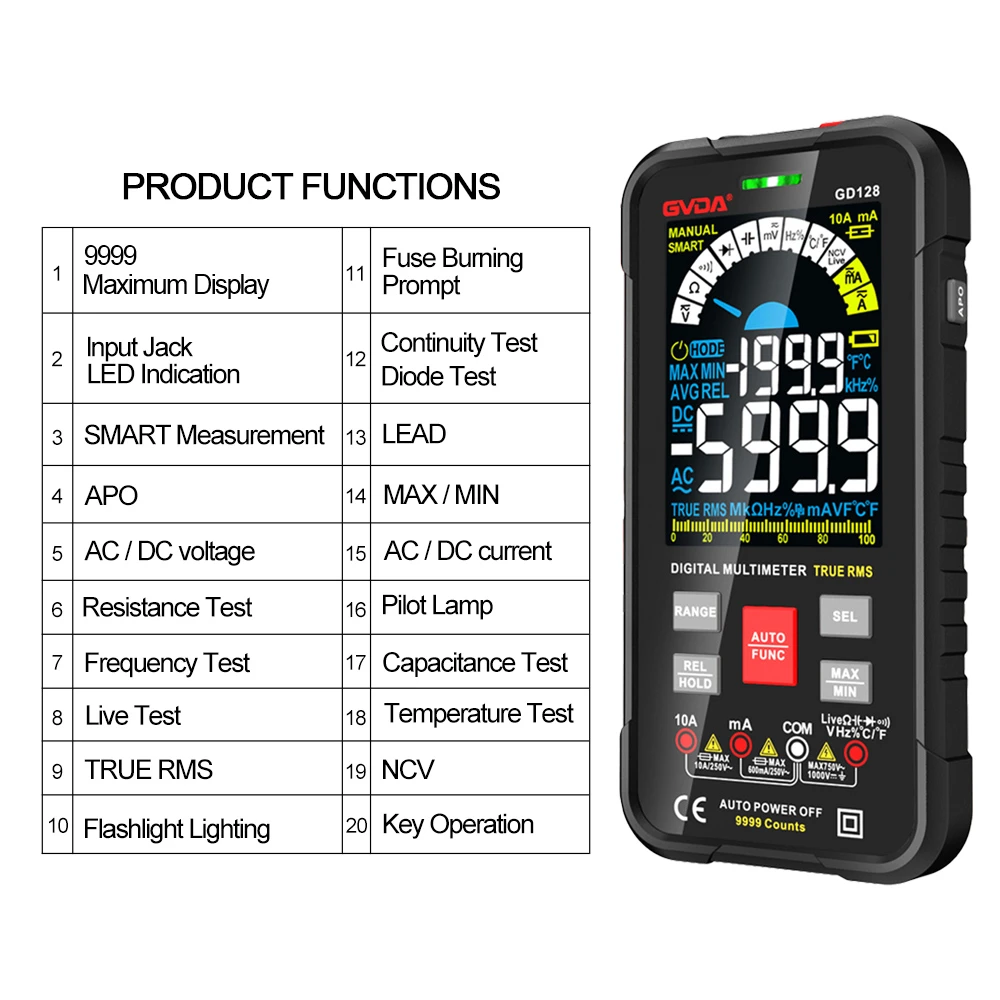
Digital multimeter voltage measurement
Digital measuring instruments have become mainstream because digital instruments have high sensitivity, high accuracy, clear display, strong overload capability, easy portability, and simpler use.
Voltage measurement
1. Measurement of DC voltage, such as batteries, walkman power supplies, etc. First insert the black test lead into the "com" hole and the red test lead into the "V Ω" hole. Select the knob to a range larger than the estimated value (note: the values on the dial are the maximum range, "V-" represents the DC voltage range, "V~" represents the AC voltage range, and "A" represents the current range), and then Connect the test leads to both ends of the power supply or battery; keep the contact stable. The value can be read directly from the display. If it is displayed as "1.", it means that the measuring range is too small, so it is necessary to increase the measuring range before measuring industrial electrical appliances. If "-" appears on the left side of the value, it means that the polarity of the test lead is opposite to the actual power supply polarity. At this time, the red test lead is connected to the negative pole.
2. Measurement of AC voltage. The test lead jack is the same as the DC voltage measurement, but the knob should be turned to the required range at the AC gear "V~". There is no positive or negative distinction between AC voltage, and the measurement method is the same as before. Regardless of whether you are measuring AC or DC voltage, you must pay attention to your personal safety and do not touch the metal parts of the test leads with your hands.
Precautions for using digital multimeter
1. If the magnitude of the voltage or current to be measured cannot be estimated in advance, you should first measure it to the highest range, and then gradually reduce the range to the appropriate position depending on the situation. After the measurement is completed, the range switch should be moved to the highest voltage range and the power supply should be turned off.
2. At full scale, the meter only displays the number "1" in the highest digit, and the other digits disappear. In this case, a higher range should be selected.
3. When measuring voltage, the digital multimeter should be connected in parallel with the circuit under test. When measuring current, it should be connected in series with the circuit under test. When measuring DC flow, there is no need to consider the positive and negative polarity.
4. When the AC voltage block is misused to measure DC voltage, or the DC voltage block is misused to measure AC current, the display will display "000", or the low-digit numbers will jump.
5. It is prohibited to change the range when measuring high voltage (above 220V) or large current (above 0.5A) to prevent arcing and burning of switch contacts.