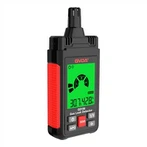
Do you know what an anemometer is used for?
The basic principle of an anemometer is to place a thin metal wire in a fluid, and heat the wire through an electric current to make its temperature higher than that of the fluid, so the wire anemometer is called a "hot wire". When the fluid flows through the wire in the vertical direction, it will take away part of the heat of the wire and reduce the temperature of the wire.
The use of anemometer:
1. Measure the velocity and direction of the average flow.
2. Measure the pulsation velocity and frequency spectrum of the incoming flow.
3. Measure the Reynolds stress in turbulent flow and the velocity dependence and time dependence of two points.
4. Measure wall shear stress (usually by using a hot film probe placed flush with the wall, the principle is similar to hot wire velocity measurement).
5. Measure the fluid temperature (measure the change curve of the probe resistance with the fluid temperature in advance, and then determine the temperature according to the measured probe resistance.