Do you know which aspects are the key to the applicable industry and operating skills of the anemometer?
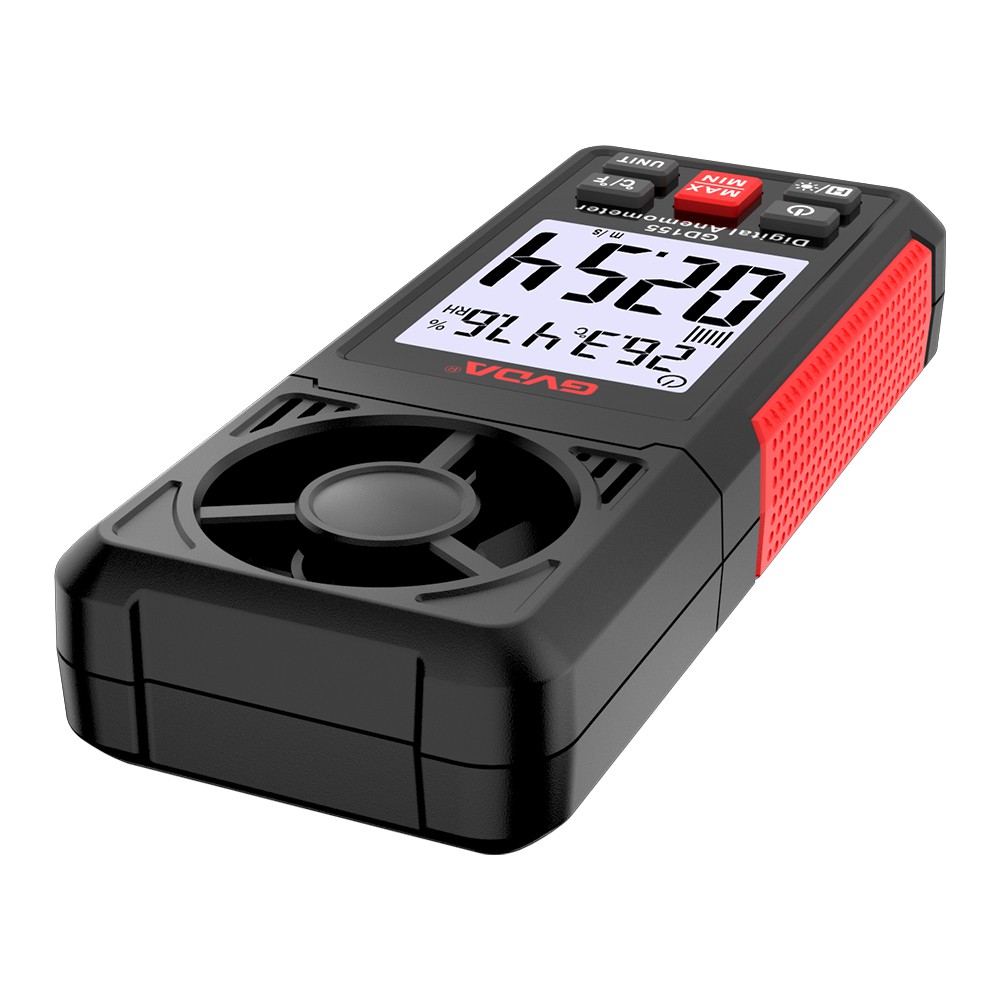
Anemometer, as the name suggests, is an instrument for measuring air velocity. There are many types of it, and the anemometer is a common anemometer. The rotating cup anemometer was first invented by Robinson in England. At that time, there were four cups, and then three cups were used instead. The three parabolic or hemispherical empty cups fixed on the frame are all along one side, and the whole frame together with the wind cup is mounted on a shaft that can rotate freely. The three-cup anemometer is commonly used in meteorological stations. It consists of three parabolic cone empty cups fixed on the bracket at 120° to each other to form the sensing part. The concave surfaces of the empty cups are all in one direction. The whole induction part is installed on a vertical rotating shaft, and under the action of wind force, the wind cup rotates around the shaft at a speed proportional to the wind speed. Another rotary anemometer is the propeller anemometer, which consists of a three-blade or four-blade propeller as the sensing part, which is installed on the front end of a wind vane so that it is always aligned with the direction of the wind. The blades rotate around a horizontal axis at a speed proportional to the wind speed.
Fields of application of anemometers
Anemometers are widely used and can be used flexibly in all fields. Anemometers can be widely used in electric power, steel, petrochemical, energy-saving and other industries. There are other applications in the Beijing Olympic Games, sailing competitions, rowing competitions, field Anemometers are needed for shooting competitions and so on. The current anemometer is relatively advanced, in addition to measuring wind speed, it can also measure wind temperature and air volume. There are many industries that need to use anemometers, recommended industries: fishing industry, various fan manufacturing industries, industries that require ventilation and exhaust systems, etc.
Anemometer detection method
A. Air volume and wind speed detection must be carried out first. All purification effects are obtained under the designed air volume and wind speed.
B. Before testing, check whether the fan is operating normally. The size of the air outlet and air duct to be tested must be measured on the spot.
C. For a unidirectional flow (laminar flow) clean room, the air volume is determined by the product of the average wind speed of the room section and the product of the clean area.
(Take the section 0.3m away from the filter perpendicular to the airflow as the sampling section, and set no less than 5 test points on the section according to the test point spacing should not be greater than 0.6m, and the arithmetic mean of all readings is taken as the average wind speed.) Vertical single The measurement section of the direction flow (laminar flow) clean room is based on the horizontal section of 0.8m~1m on the ground; the measurement section of the horizontal unidirectional flow (laminar flow) clean room is based on the vertical section of the air supply surface of 0.5m~1m; The number of test points should not be less than 10, and the distance between them should not be greater than 2m, and they should be evenly arranged.
D. For the tuyere equipped with a filter, the air volume is determined by the product of the average wind speed of the tuyere section and the net cross-sectional area of the tuyere. (Average wind speed is obtained from not less than 6 uniformly arranged test points on the section of the tuyere or the section referencing the auxiliary air duct.)
E. When there is a long branch pipe section on the windward side of the tuyere and holes have been or can be drilled, the air volume can be determined by the air duct method. (Drill holes not less than 3 times the pipe diameter or 3 times the length of the large side before the air outlet;)
F. For rectangular air ducts, divide the measured section into several equal small sections, each small section is as close to a square as possible, the side length is not greater than 200mm, the test point is located in the center of the small section, but the entire section should not be less than 3 tests For circular air ducts, the measurement section should be divided and the number of test points should be divided according to the equal-area circular method; holes should be opened on the outer wall of the air duct, and thermal anemometer probes or pitot tubes should be inserted. (Converted to air volume by measuring dynamic pressure.)