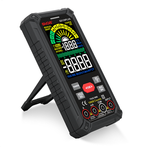
Does the resistance shift need to be calibrated for the multimeter to measure it?
A multimeter's ohm range can be used to measure a conductor's resistance. The symbol "" stands for the ohm file, which is composed of the four files R1, R10, R100, and R1K. Additionally, some multimeters have R10k files. Measure the resistance in ohm mode using a multimeter. The actions listed below should be taken in addition to the conditions that need to be met prior to usage.
1. Switch the selector switch to the R100 position, connect the two test leads in series, and turn the ohm position's zero position adjustment knob until the hands are pointing at the zero position at the right end of the resistance scale. If the pointer cannot be set to zero, the watch's battery's voltage is insufficient, and a new battery needs to be purchased.
2. To measure the resistance, contact the two pins of the measured resistance with two test leads. The measured resistor's resistance value is obtained by correctly reading the value of the resistance indicated by the pointer and then multiplying it by the magnification (R100 gear should be multiplied by 100, R1k gear should be multiplied by 1000, etc.).
3. The pointer should be in the middle of the scale line while taking the measurement to increase accuracy. The R1k gear should be utilized if the pointer deflection angle is modest, and the R1O gear or R1 gear should be utilized if the pointer deflection angle is big. The ohm gear's zero adjustment knob needs to be adjusted once more and then measured after each gear shift.
4. After the measurement, the test leads should be removed, and the selector switch should be set to the maximum AC voltage setting or the "OFF" position. Put the multimeter aside.
The principle of measuring resistance with a meter is the single-coil ohmmeter method. Since the resistance value connected to each resistance gear is different, it increases by 10 times, such as ×1, ×10, ×100, ×1000, ×10k. When the terminals are short-circuited, the internal resistance of the battery is connected in series with the internal resistance of the meter head and the resistance of the ×1 gear. When the battery voltage remains constant, the current flowing through the meter head coil corresponds to the zero ohm, that is, zero The terminal voltage of the meter head coil of the bit is constant. If the resistance value of each gear is changed, the terminal voltage of the meter head will change, so that the current flowing through the meter head will also change accordingly, and the meter needle will no longer point to the ohm zero position. For example, when the resistance gear is changed from R × 1 gear to high gear one by one, the meter voltage and current decrease gradually, and the deflection of the pointer will be less than zero ohm, which will cause a large measurement error. Therefore, the zero adjustment knob must be adjusted to keep the coil current of the meter head unchanged, so that the pointer points to the ohm zero position again, so as to ensure the accuracy of each gear when measuring.