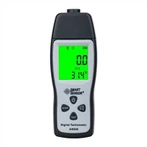
Electromagnetic radiation monitoring
The measurement of electromagnetic pollution monitoring is actually the measurement of electromagnetic radiation intensity, including the measurement of the near field strength, the measurement of the far field strength, and the microwave leakage energy test. According to the measurement site, it can be divided into operation environment monitoring, specific public exposure environment monitoring (such as radiation source adjacent environment) and general public exposure environment monitoring; according to measurement parameters, it can be divided into monitoring of electric field intensity, magnetic field intensity and electromagnetic field rate flux density. Different types of instruments should be used for different measurements in order to obtain the best measurement results. Electromagnetic radiation monitoring instruments are divided into non-frequency-selective broadband electromagnetic radiation monitors and frequency-selective electromagnetic radiation monitors according to the purpose of measurement. The former is used for the measurement of strong electromagnetic radiation fields in the environment, and the latter is used for the measurement of low electromagnetic radiation fields in the environment. The electromagnetic radiation monitoring of the working environment should be carried out during the normal working time of the electromagnetic radiator. Each measurement point should be measured continuously for 5 times, and each time should not be less than 15 seconds, and the maximum value of the stable condition should be read. If the measurement reading fluctuates greatly, the measurement time should be appropriately extended. In addition to selecting the operating position of the operator, the measurement location should also select the environment of the auxiliary facilities of the electromagnetic radiator, the environment of the duty room, etc. The measurement time of environmental electromagnetic radiation monitoring should be selected in the peak period of electromagnetic radiation of urban environment or the normal working time of electromagnetic radiator. The observation time for each measurement is not less than 15 seconds. If the measurement reading fluctuates greatly, the measurement time should be extended. The other two types of environmental electromagnetic radiation monitoring also have their own characteristics. ①Specific public exposure environment monitoring. When monitoring the environment around a certain electromagnetic radiation source such as a TV transmission tower, the electromagnetic radiator is taken as the center, and the 8 azimuths at an interval of 45° are used as measurement lines. Fixed-point monitoring at different distances such as 50 meters and 100 meters. The monitoring range is that the radiator power is greater than 100 kWh, and its radius is 1 km; the radiator power is less than or equal to 100 kWh, its radius is 0.5 km, or determined according to the actual situation. ②The general public is exposed to environmental monitoring. When monitoring the electromagnetic radiation of a city or a region, the measurement range is divided into 1km × 1km or 2km × 2km squares on the mapping map, and the center of the square is taken as the measurement point. The actual measuring point should avoid high-rise buildings, trees, high-voltage lines and metal structures, etc., and try to choose an open place for testing. The maximum distance of measuring point adjustment is 1/4 of the side length of the square. No monitoring is allowed for measuring points in special areas. The monitoring results are generally represented by corresponding curves such as frequency-field strength, time-field strength, time-frequency, measurement position-total field strength, typical electromagnetic radiator environmental pollution diagrams, and residential area environmental pollution diagrams. [1]