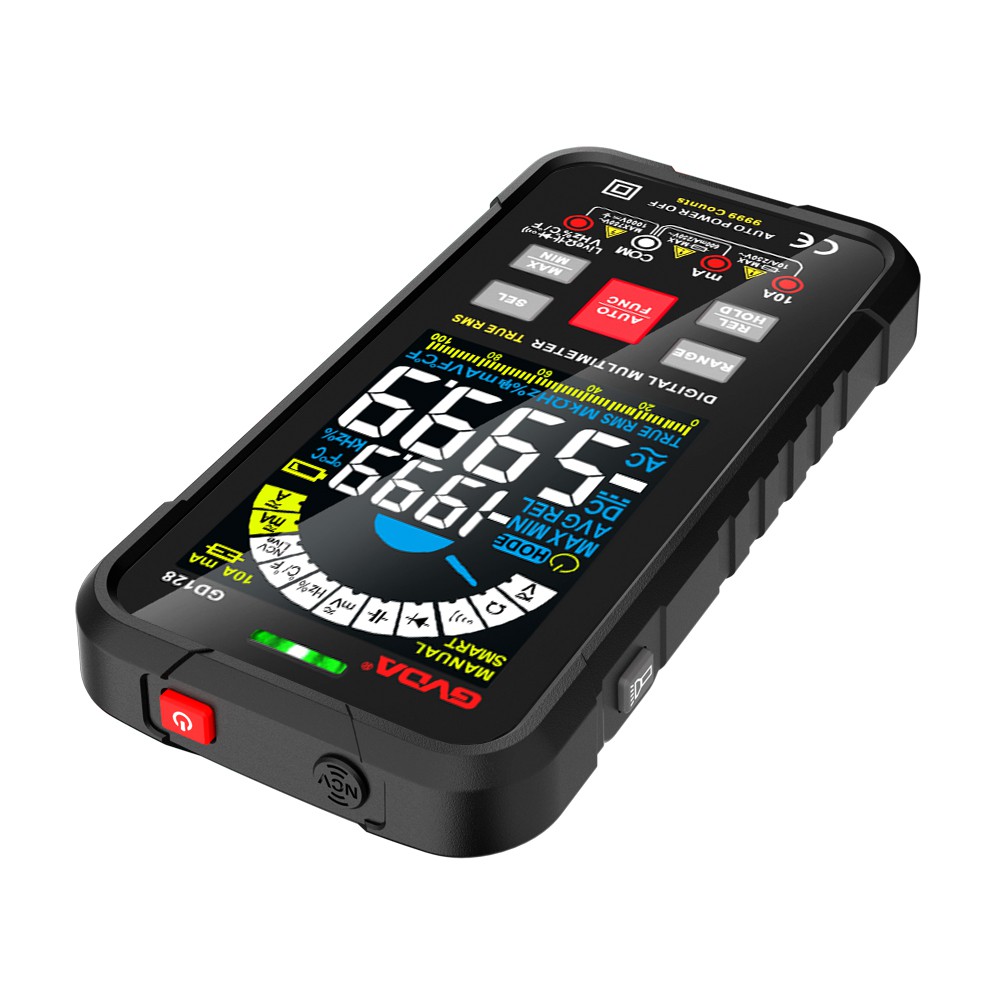
Error analysis of measuring different voltages with the same range of multimeter
The multimeter is composed of three main parts: meter head, measuring circuit and changeover switch.
The multimeter is the most basic tool in the field of electronic testing, and it is also a widely used testing instrument. Multimeters are also called multimeters, three-purpose meters (A, V, Ω are current, voltage, and resistance), multimeters, and multimeters. Multimeters are divided into pointer multimeters and digital multimeters. There is also a multimeter with oscilloscope function. The oscilloscope multimeter is a multi-functional, multi-range measuring instrument. General multimeters can measure DC current, DC voltage, AC voltage, resistance and audio level, etc., and some can also measure AC current, capacitance, inductance, temperature and some parameters of semiconductors (diodes, triodes). Digital multimeters have become mainstream and have replaced analog meters. Compared with analog instruments, digital instruments have high sensitivity, high precision, clear display, strong overload capacity, easy to carry, and more convenient and simple to use.
The error produced by measuring two different voltages with the same range of a multimeter
For example: MF-30 multimeter, its accuracy is 2.5, use the 100V gear to measure a standard voltage of 20V and 80V, which gear has the smaller error?
Maximum relative error: △A%=maximum absolute error △X/measured standard voltage adjustment×100%, maximum absolute error of 100V block △X(100)=±2.5%×100V=±2.5V.
For 20V, its indication value is between 17.5V-22.5V. Its maximum relative error is: A(20)%=(±2.5V/20V)×100%=±12.5%.
For 80V, its indication value is between 77.5V-82.5V. The maximum relative error is: A(80)%=±(2.5V/80V)×100%=±3.1%.
Comparing the maximum relative error of the measured voltage 20V and 80V, it can be seen that the error of the former is much larger than that of the latter. Therefore, when using the same range of a multimeter to measure two different voltages, whoever is closer to the full scale value will have higher accuracy. Therefore, when measuring voltage, the measured voltage should be indicated above 2/3 of the multimeter's range. Only in this way can the measurement error be reduced.
The basic principle of the multimeter is to use a sensitive magnetoelectric DC ammeter (microampere meter) as the meter head.
When a small current passes through the meter head, there will be a current indication. However, the meter head cannot pass a large current, so some resistors must be connected in parallel or in series on the meter head to shunt or lower the voltage, so as to measure the current, voltage and resistance in the circuit.