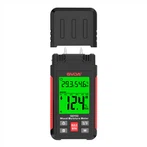
Experts share their experience in debugging infrared thermometers
1. Problems that arise:
1. Calibration is inconvenient and downloading is difficult; there is a lot of interference between internal components.
2. The temperature display value is unstable and jumps up and down.
3. There is a 15°C jump after the temperature reaches 900°C.
2. Analyzing the problem:
1. The design of the download port is not correct, only ports such as online debugging are led out, and RXD and TXD are not led out; the PCB design is unreasonable, and the wiring layout is disordered.
2. The internal power supply problem, the power supply ripple is very large, especially the ripple effect of the MCU reference voltage is very important, the smaller the better.
3. When the temperature rises, use an oscilloscope to measure the ADC input waveform as a sine wave before the temperature value jumps. After the jump, the waveform is smooth. When the temperature drops, the waveform is very smooth before the laser is turned on, and the laser turns into a sine wave again. The analysis shows that the amplifier circuit has Self-excited oscillation, the beating after 900 degrees is caused by the oscillation to stop the vibration, when the oscillation cannot be maintained at a certain temperature, the vibration will stop, it will be the average value, and there will also be a sudden change at this time, so there is a 15 degree beating; because The start-up condition is higher than the oscillation condition, so the temperature drops until the laser starts to oscillate. From the back to the front, the oscillation of the result measured with an oscilloscope comes from the first-stage amplifier circuit. To realize sine wave self-excited oscillation, there is a frequency f0 in the low frequency or high frequency band, so that the additional phase shift generated by the circuit is ±∏, and when f=f0 |AF|>1, self-excited oscillation will occur. In addition to being determined by the resistance and capacitance in the circuit, the oscillation frequency also depends on uncertain factors such as the interelectrode capacitance of the transistor and the distributed capacitance of the circuit. (The sine wave oscillating circuit must satisfy 0 degree or 360 degree integral multiple flipping, that is, ∮=2n∏, and |AF|=1, but the start-up condition is |AF|》1).
3. Solve the problem:
1. Redesign the circuit and lead out other ports to realize the functions of serial port download and calibration data real-time burning, which makes the operation simple, easy to calibrate, and the data more accurate; re-layout and wiring, so that the bottom layer has a large area of copper (connected to the ground) , to reduce the interference between devices.
2. Select a high-precision voltage regulator chip to reduce the ripple of the input power supply, and add an RC filter circuit or a filter capacitor directly before the input. In this way, the work of MCU, operational amplifier, voltage-to-current and other chips will be relatively stable. The stable reference voltage makes the internal data of the MCU stable, and the output data is correspondingly stable and accurate.
3. This problem has been debugged for a long time, and many methods have been used based on theoretical knowledge, but some effects are not obvious. ①. Change the magnification (change the feedback resistance value), if the magnification is too large, oscillation will occur. But there is no response to changing the resistance value of dozens of K in this circuit, and it is still the same as before. The possible reason is that the internal resistance of the detector is too large, so changing the resistance has little effect; Compared with the original waveform, the oscillation frequency becomes faster, and the oscillation range is widened, and the oscillation has not stopped when the temperature rises beyond the effective value range; ③. On the basis of ②, the primary amplification output point is also the secondary amplification input Adding an RC filter circuit at the point, the effect is quite obvious. After a suitable value is given, the waveform at the ADC, that is, the output point of the secondary amplification, becomes smooth and there is no jump. This is a very good method, but the pre-amplification still has oscillation, which will have a certain impact on the data, so we should consider other methods to prevent the circuit from oscillating; ④, because the detector is made of a PIN diode, and The PIN diode has a certain capacitive capacity, so it will be combined with the feedback resistor to form an RC oscillator circuit. If the capacitive part of the PIN diode is weakened and turned into a resistive one, self-excited oscillation will not occur, so there is a series connection there. The appropriate resistance waveform also becomes very beautiful, but there is still a jump at 900°C, so the oscillation range has to be extended, ② that step still needs to be done.
Fourth, debugging experience:
1. The use of digital oscilloscopes, such as data reading and adjustment, has not reached a certain level in hardware debugging, and there is not enough ability to analyze the source of reasoning problems. Oscilloscopes are a key tool. In the use of the oscilloscope, ①, use the appropriate gear, such as: use the AC gear to measure the ripple of the power supply, if you use the DC gear, there is no response when the small AC signal is superimposed on the DC; ②, grounding during the test Be sure to be close to the test point.
2. Really understand some working principles of RC filter circuits. RC circuits have different purposes when used in different places. As far as this circuit is concerned, the RC of the probe head produces oscillations, and we don’t want these oscillations later. Wave, we can use RC circuit to filter out these waves, its frequency f=1/2∏RC, this is the passband in the frequency selection circuit, and in the filter circuit, it is to filter out the clutter in this frequency band.
3. The capacitive problem of diodes. Most people will ignore the capacitive nature of diodes when they use diodes. In particular, PIN diodes have stronger capacitive capacity due to the part of the intrinsic semiconductor sandwiched in the middle of the PN junction, which can be equivalent to parallel connection. A large capacitor is added, and this capacitor and the feedback resistor form an RC oscillation circuit, and there is a third problem-there is a 15°C jump at around 900°C, and the temperature display does not stabilize after the jump.