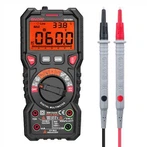
Explanation of other uses of the electric tester
In addition to determining whether an object is electrically charged or not, the electric tester has several other uses:
(1) It can be used for low-voltage phase verification, measuring whether any conductors in the line are in the same phase or different phases from each other.
Specific method is: stand on an object insulated from the earth, hands each holding a stylus, and then in the two wires to be tested on the test, if the two stylus luminous is very bright, the two wires for the different phase; vice versa, it is the same phase, it is the use of the tester in the neon bubbles between the two poles of the difference in voltage and its luminous strength is directly proportional to the principle to discriminate.
(2) can be used to distinguish between alternating current and direct current. In the test with a stylus, if the stylus neon bubble in the two poles are luminous, is the alternating current; if the two poles only one pole is luminous, it is direct current.
(3) can determine the positive and negative poles of direct current. Will be connected to the test pen in the DC circuit test, neon bubble light up the pole is the negative pole, does not light up the pole is positive.
(4) can be used to determine whether the DC ground. Insulated to ground in the DC system, can stand on the ground with a stylus contact DC system in the positive or negative pole, if the stylus neon bubble does not light up, there is no grounding phenomenon. If the neon bubble is bright, it shows that there is a grounding phenomenon, and its bright such as in the pen **, it shows that the positive pole is grounded. If the light in the finger end, it is negative grounding. However, it must be pointed out that in the DC system with a ground monitoring relay, can not be used to determine whether the DC system is grounded.