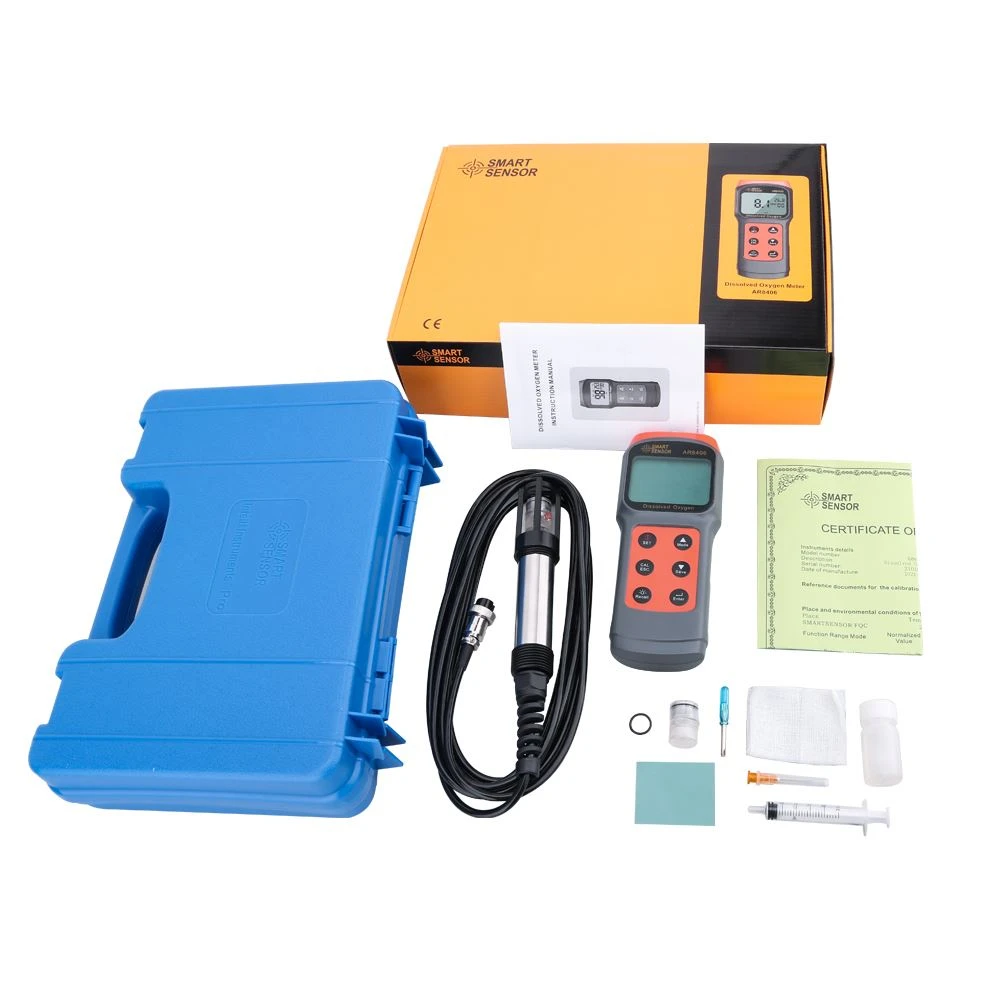
The oxygen content in water can fully show the degree of water self-purification. For biological treatment plants using activated sludge, it is very important to understand the oxygen content of the aeration tank. The increase in dissolved oxygen in the sewage will promote biological activities other than anaerobic microorganisms, so it can remove volatile substances and natural oxidation. ions to purify sewage.
There are three main methods for determining oxygen content: automatic colorimetric analysis and chemical analysis measurement, paramagnetic measurement, electrochemical measurement, and fluorescence method. The amount of dissolved oxygen in water is generally measured by electrochemical methods.
Oxygen is soluble in water, and the solubility depends on the temperature, the total pressure on the water surface, the partial pressure, and the dissolved salts in the water. The higher the atmospheric pressure, the greater the ability of water to dissolve oxygen, and the relationship is determined by Henry's law and Dalton's law, which states that the solubility of a gas is proportional to its partial pressure.
The oxygen measurement sensor consists of a cathode (commonly made of gold and platinum) and a counter electrode (silver) with current and a reference electrode (silver) without current. The electrode is immersed in an electrolyte such as KCl, KOH, and the sensor is covered with a diaphragm. The membrane separates the electrode and the electrolyte from the liquid to be measured, and only dissolved gas can penetrate the membrane, thus protecting the sensor, preventing both the electrolyte from escaping and the intrusion of foreign substances from causing contamination and poisoning.
A polarizing voltage is applied between the counter electrode and the cathode. If the measuring element is immersed in water with dissolved oxygen, the oxygen diffuses through the diaphragm and the oxygen molecules present on the cathode (excess electrons) are reduced to hydroxide ions [ OH-]. An electrochemical equivalent of silver chloride is precipitated on the counter electrode (deficient in electrons), and for each oxygen molecule, the cathode emits 4 electrons and the counter electrode accepts electrons, forming a current: 4Ag+4Cl-=4AgCl+4e-.
Dissolved oxygen detector
Dissolved oxygen detector
The magnitude of the current is proportional to the oxygen partial pressure of the measured sewage. The signal is sent to the transmitter together with the temperature signal measured by the thermal resistance on the sensor, and the difference between the oxygen content stored in the sensor and the oxygen partial pressure and temperature is used. The relationship curve calculates the oxygen content in the water, and then converts it into a standard signal output. The function of the reference electrode is to determine the cathodic potential.
Digital Lux meter Product link Dissolved Oxygen Meter AR8406:
Pls Clink Below Photo and Read more details about this Dissolved Oxygen Meter AR8406: