How to accurately measure the pH of organic solvents?
First of all, strictly speaking, the pH in organic solvents, or non-aqueous solvents, is an imprecise statement.
pH is the negative logarithm of the concentration of hydrogen ions in aqueous solution, but there are no free hydrogen ions (protons) in aqueous solution, only hydronium ions H3O+ (even more complex hydronium ions), and the ionization nature of protonic acids in water is Proton transfer, let the acid be represented by HA: HA + H2O ⇌ A- + H3O+ That is to say, the acid HA transfers the proton to water, the acid becomes the conjugate base A-, and the water becomes H3O+, H3O+ can also be regarded as a An acid, then water is actually equivalent to a base in this ionization.
The pH measurement is actually the concentration of H3O+ in an aqueous solution, more precisely, the activity of solvated hydrogen ions (H3O+) in an aqueous solution. In non-aqueous solvents, the target of the acid to transfer protons is not water, and the generated H3O+ is not. Therefore, to compare acidity, the ability of the acid to donate protons should be considered. It is best not to use the concept of measuring the pH value. If you must use an approximate The concept can be used to measure the activity of (solvated) hydrogen ions in non-aqueous solvent solutions. Of course, if you want to call the negative logarithm of the activity of solvated hydrogen ions in a non-aqueous solvent solution also called "the pH value in a non-aqueous solution", that's okay.
For example, in glacial acetic acid solvent, the ionization of acid HA can be expressed as: HA + CH3COOH ⇌ A- + CH3C(OH)2+CH3C(OH)2+ is the solvated hydrogen ion in glacial acetic acid solvent, its activity ( It can be approximated as the negative logarithm of the concentration in dilute solution, and it can also be called the "pH value" in glacial acetic acid solvent. The "pH value" in this non-aqueous solvent is not necessarily usually between 0-14, and "neutral" does not necessarily correspond to pH=7, because the ion product (298.15K) of water is 1*10^ (-14). There are roughly two measurement methods, and the basic idea is similar to that in aqueous solution:
1. Indicator method, choose an indicator that can undergo color change when receiving protons in a non-aqueous solvent. In fact, many acid-base indicators can be used in non-aqueous solvents. pH test paper can often measure a certain "pH value" in non-aqueous solvents. A small amount of phenolphthalein alcohol solution can be dripped into concentrated sulfuric acid or concentrated phosphoric acid. Obvious red color can be seen. The orange-yellow color is caused by the protonation of phenolphthalein by a strong acid and the loss of water to form a compound with a trityl positive ion structure. To measure the acidity of superacids, that is, the protonation ability, that is, to use appropriate indicators, plus colorimetric or spectrophotometric determination. If you can choose a suitable indicator and add spectrophotometry, you can compare the activity of hydrogen ions in non-aqueous solvent solutions. The disadvantage is that the measurement of the absolute value often requires complicated calibration and the accuracy is not high.
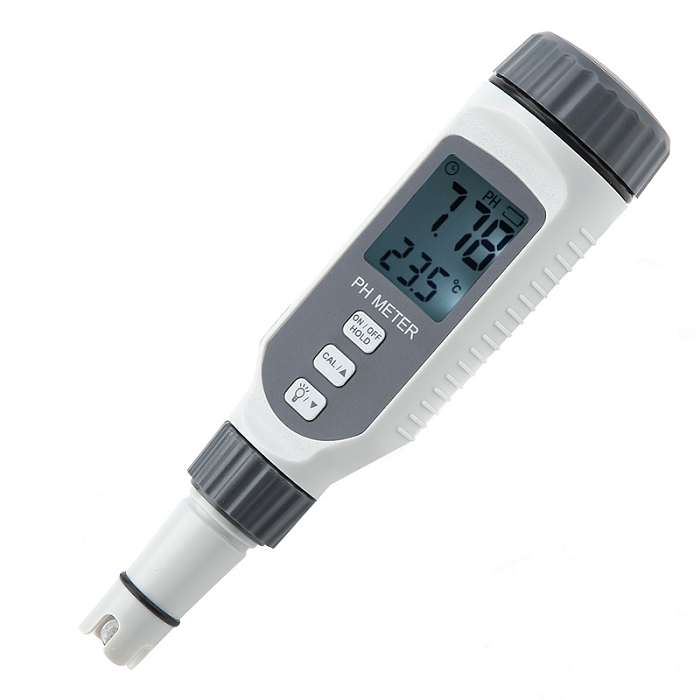
2. Potentiometric method, select the hydrogen ion selective electrode (hydrogen ion indicating electrode) in the non-aqueous solvent, and cooperate with the reference electrode for determination. The most common hydrogen ion selective electrode - glass electrode, generally speaking, can be used in non-aqueous solvents, but must be re-calibrated in non-aqueous solvents; but the reference electrode must be a non-aqueous solution reference electrode, usually Gan The mercury electrode is a KCl aqueous electrolyte, which generally cannot be used directly for non-aqueous solutions. If it is used reluctantly, it will easily lead to unstable measurement and increase errors due to the influence of the liquid junction potential. It is best to choose an Ag-AgCl electrode suitable for non-aqueous solutions. etc. There are many manufacturers supplying them, and you can find the ones suitable for the solvent you use on the Internet. Connect the appropriate hydrogen ion selective electrode and reference electrode to the pH meter, and it can be measured like the pH value in aqueous solution, but it must be calibrated to achieve accurate measurement. If it is not calibrated, the measured "pH value" Only for reference. If it is an acid-base titration in a non-aqueous solvent, then just use the potential or "pH value" jump point as the equivalence point. The range of the pH meter should also be selected well, and the "pH value" in non-aqueous solvents often exceeds the range of 0-14.