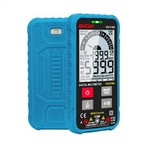
How to Calibrate a Multimeter How a Multimeter Works
A multimeter, like other measuring instruments, is calibrated by the manufacturer before leaving the factory. Therefore, if there are no significant issues, please do not adjust it arbitrarily. The current multimeter usually has a voltmeter head, so when calibrating other gears, it is necessary to first calibrate the DC voltage gear, which is called the basic gear by industry insiders. If this gear is inaccurate, almost every gear and function (except for the resistance gear) may be inaccurate. Generally, a multimeter will set one potentiometer (such as DC voltage mode) or multiple potentiometers (such as temperature mode) for each function, and there are also those without potentiometers (such as resistance mode). It's easy to do with potentiometers. Just input the detection signal and adjust it directly; Without a potentiometer, there is usually no misalignment. In case of misalignment, it may be caused by instrument damage or poor circuit contact.
The DC resistance of the starting winding of single-phase electricity is generally greater than that of the running winding. A relatively simple method of discrimination is:
1. First, use a multimeter to measure the DC resistance from the common end to the running winding end and the starting winding end respectively
2. Then use a multimeter to measure the DC resistance from the running winding end to the starting winding end.
3. If the arithmetic sum of the two measurements in "1" is not equal to the measurement in "2", then the motor must have burned out! If they are equal, they can be compared with motors of the same model, or the factory parameters of the motors can be found for comparison. To determine the quality of the motor.
Method and steps for measuring AC voltage with a multimeter
1, Method for measuring AC voltage: 1. Insert the black probe into the COM socket and the red probe into the V/Ω socket. 2. Place the function switch in the AC voltage range of V~range, and connect the test pen to the power supply or load to be tested. 3. When measuring AC voltage, there is no polarity display. 4. Whether measuring AC or DC voltage, personal safety should be taken into account and the metal part of the probe should not be touched casually. For example, when measuring AC 220V, turn the switch to the desired voltage range (when measuring AC 220V, the switch should be turned to AC 750V). When measuring, the test pen should be connected in parallel to the circuit being tested. If you don't know the range of the measured voltage, you can first use a larger limit to measure the approximate value, and then switch to the corresponding limit measurement.
2, Operation prompt 1: Select the AC voltage gear. When the voltage range is unknown, start from the maximum range. 2. The table should be connected in parallel at both ends of the tested circuit or component.
3, The first step in measuring AC voltage is to turn on the power switch of the digital multimeter and rotate the multimeter to the AC voltage range of 750V. Step 2: Turn on the power switch in the circuit. Step 3: Measure the voltage between points 1-2, record the reading, and the voltage value is measured as 220V. Step 4: Rotate the multimeter to the AC voltage range of 20V, measure the voltage between points 3-4, 4-5, and 6-7, and record the readings. (1) The voltage measured between points 3-4 is 10V. (2) The voltage measured between points 4-5 is 10V. (3) The voltage measured between points 6-7 is 6.2V.