How to choose a digital multimeter
When using a digital multimeter, you should not only look at the basic standard, but also its characteristics, functions and overall planning and production goals. The following are the basic goals and functions of digital multimeters that need to be considered.
1. Reliability: Especially under harsh conditions, reliability is more important than ever.
2. Safety: The first question to consider in the digital multimeter design is that it has passed the independent test of the certified laboratory, and is printed with the symbols of testing laboratories such as UL, CSA, VDE, etc.
3. Resolution: Resolution, also known as sensitivity, refers to the smallest quantification unit of the measurement effect of a digital multimeter, that is, the subtle changes in the measured signal can be seen. For example: Assuming that the resolution of the DMM is 1mV in the 4V scheme, then when measuring a 1V signal, you can see a small change of 1mV. The resolution of a digital multimeter is usually indicated in digits or words.
Digital multimeter resolution is a very important target, just like if you want to measure lengths less than 1mm, you must not use a ruler with the smallest unit in centimeters; perhaps the temperature is 98.6°F, then measuring with a thermometer that only needs an integer sign is No use, you need a thermometer with a resolution of 0.1°F.
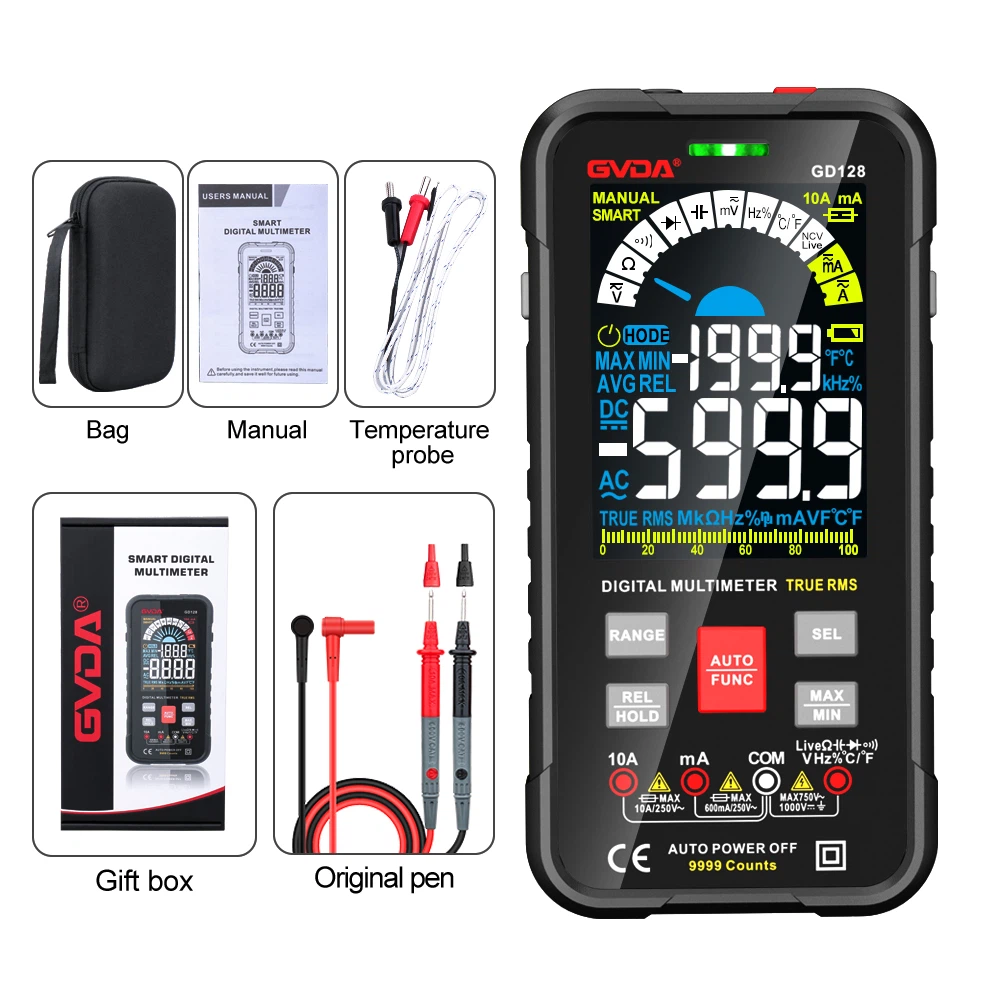
A 3.5-digit watch, the last three digits can flash three full digits from 0 to 9, and the first digit only flashes one and a half digits (flashing 1 or no flashing), that is, a 3.5-digit digital watch can reach 1999 words resolution; a 4½-digit digital multimeter can reach a resolution of 19,999 words. The resolution of a digital table is better in words than in bits. The resolution of today's 3½-digit DMMs has now progressed to 3200 or 4000 words. A 3200-word DMM provides very good resolution for some measurements. For example, a 1999 word meter, when measuring voltages greater than 200V, you cannot flash to 0.1V. The 3200-word digital multimeter can still flash to 0.1V when measuring the voltage of 320V. When the measured voltage is higher than 320V and the resolution of 0.1V is to be reached, a 20,000-character digital multimeter with an expensive price is required.
4. Accuracy: Refers to the maximum allowable error in a specific operating environment. In other words, accuracy is used to indicate how close the digital multimeter's measurement is to the actual value of the signal being measured. For digital multimeters, accuracy is usually stated as a percentage of the reading. For example, a reading accuracy of 1% means that when the digital multimeter displays ten 0.0V, the actual voltage may be between 99.0V and ten 1.0V. In the specific description book, there may be a specific value plus the final subprecision, and its meaning is the number of words to be added to change the rightmost end of the flash. In the previous example, the accuracy might be marked as ±(1%+2). Thus, assuming the multimeter reads ten 0.0V, the actual voltage will be between 98.8V and ten 1.2V. The accuracy of an analog meter (or pointer multimeter) is calculated as a full-scale error, not a flashed reading. The typical accuracy of an analog multimeter is ±2% or ±3% of full scale. The typical basic accuracy of a DMM is between ±(0.7%+1) and ±(0.1%+1) of reading, or even higher.
5. Ohm's rule: Ohm's rule reminds the connection between voltage, current and resistance. Using Ohm's rule, any circuit voltage, current, and resistance can be calculated: voltage = current × resistance. Therefore, the third value can be calculated only by knowing any two values in the formula. A digital multimeter uses the Ohm rule to measure and display resistance, current or voltage.
6. Digital and analog pointer display: In terms of precision and resolution, digital display has excellent advantages, and the measured value can be displayed with three or more digits. Similar to pointers that are slightly inferior in accuracy and resolution, we usually rely on estimating the position of the pointer to read. The digital multimeter has a bar graph that mimics the same flashing signal changes and trends as a pointer, but it is more durable and less damaged.