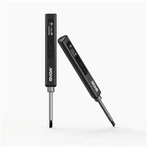
How to deal with electric soldering iron not eating tin
The soldering iron head I used to use was a copper head, which became shorter and shorter as I used it. Two years ago, a parent of a student who runs an electrical appliance business gave me a 30W alloy head soldering iron and a roll of welding wire.
Although it is a 30W soldering iron, when it is used to solder circuits for a long time, the tin on the soldering iron head dries up and does not stick to the tin. Sometimes, the more urgent and annoying it becomes, what should we do?
My 30W and 20W soldering irons are plugged into a voltage regulator
Keep the soldering iron not cold, without generating excessive heat and oxidation that does not stick to tin. When a large welding point with high temperature is needed, adjust the voltage to 220V, which is very useful.
People with conditions can buy soldering wire products, the smaller the diameter, the brighter the silver, the better.
A family that doesn't often use radios cannot lack a soldering iron. When there is no soldering wire, it can be collected by melting rosin on the back of the old circuit board. Every time I receive a walnut sized tin block, I don't have to buy it.
Once there is no tin on the soldering iron tip and severe oxidation occurs, it can be rubbed a few times on the cement floor. For light cases, it can be rubbed a few times on wood. After heating, it should be coated with rosin first and then tin. With rosin, the entire soldering iron tip should be covered with tin for convenient and timely use.
The higher the wattage of the soldering iron head, the more it oxidizes when it is electrified for a long time. The solution is to reduce the voltage. Several rectifier diodes can also be used, similar to the voltage reduction principle in electric hotpots, electric blankets, and electric heaters. Find a knob to convert the adjustment switch, and then assemble a soldering iron voltage regulator in a plastic box.