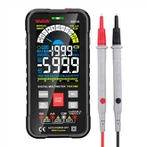
How to distinguish the multimeter gear? How to use the multimeter range switch
The three basic functions of a multimeter are to measure resistance, voltage, and current, so the seniors call it a three-meter.
Today's multimeters have added many new functions, especially digital multimeters, such as measuring capacitance value, triode magnification, diode voltage drop, etc. There is also a talking digital multimeter that can broadcast the measurement results in language. There are also many classic models of digital multimeters, such as DT830C,
DT890D, etc., the suffix at the back indicates the difference in function. Among them, DT830C has been bought for more than 30 yuan, which is cheap enough.
The biggest feature of the multimeter is that it has a range switch, and each function is switched by this switch. Basically, A- is used to represent the DC current measurement, and the milliampere and ampere files are generally divided into several files. V- means to measure DC voltage, the multimeter of the advanced point has millivolt gear, and the voltage gear is also divided into several gears. V~ is used to measure AC voltage. A~ measure the alternating current.
The resistance is measured in the Ω ohm range. For an analog multimeter, a zero adjustment is required every time the resistance range is changed. Zero adjustment is to put the red test lead and black test lead of the multimeter on the
together, and then turn the zero adjustment knob so that the pointer points to the zero position. hFE is to measure the current amplification factor of the triode. As long as the three pins of the triode are inserted into the corresponding holes on the universal panel, the hFE value can be measured. Note that PNP and NPN are different.
The following takes the MF30 multimeter as an example to illustrate the reading of the multimeter. The first scale line is the resistance value indication, the left end is infinity, the right end is zero, and the scale is uneven in the middle. There are R×1, R×10, R×100, R×1K, R×10K resistance gears, which respectively indicate the multiples of the scale indication and then multiplied to get the actual resistance value (unit is ohm).
For example, use the R×100 gear to measure a resistance, and the pointer indicates “10”, then its resistance value is 10×100=1000, that is, 1K.
The second scale line is shared by 500V gear and 500mA gear. It should be noted that the indication principle of voltage gear and current gear is different from that of resistance gear. For example, 5V gear means that this gear can only measure voltage below 5V, and 500mA gear can only measure voltage below 500mA. If the current exceeds the range, it will damage the multimeter.
This gear of the multimeter is to measure the conduction voltage drop of the diode, and it can also measure the continuity of the circuit.
How to use: Select the rotary switch to this gear, insert the test lead into the non-current gear, use the test lead to contact the two pins of the diode or the circuit test point, if the circuit is connected, the buzzer will sound, if the test is a diode, One direction will display about 0.7V, which is the diode forward voltage drop, and the other direction will display an overflow symbol, indicating non-conduction.
In addition, this gear can also measure light-emitting diodes.