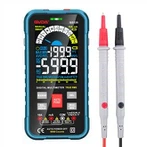
How to Distinguish the Zero Wire and the Fire Wire with a Digital Multimeter
1. First check the multimeter to see if it is in good condition, insert the black test lead into the com terminal, and insert the red test lead into the v/R terminal, and make preparations.
2. Turn the gear to AC 500v, ground the black test lead (or an object that is conductive to the earth), and touch the two wires with the red test lead respectively. It is found that the numbers on the watch have changed, and it shows that the live wire is about 220 volts. One is the zero wire.
3. Wrap the wire of the black test lead three times around your hand. Remember not to touch the test lead with your hand. The red test lead touches the two lines respectively. The one whose number changes is the live wire and the other is the zero line. (Small experience: In general, one end of the digital meter is suspended in the air, and the other end is in contact with the wire. If there is a weak digital display, it means that it is a live wire. If there is no wire, it is a neutral wire.)
In short, it is so easy to measure the neutral wire and the live wire, so let's talk about how to distinguish the live wire, the ground wire, and the neutral wire?
1. Turn the digital multimeter to the AC voltage range of 500v, first ground one of the test leads, and then connect the other test lead to the other one of the wires. If the voltage is displayed around 180~230v, it is the live wire, and then use this test lead Go to measure another line, if the voltage is around tens of volts, it is the neutral line. If only a few volts change or remain the same, this is the ground wire.
2. In terms of color, according to national regulations, yellow, green and red are phase wires, blue wires are neutral wires, and yellow and green are ground wires.