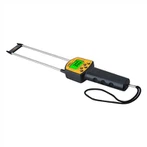
How to install a thermocouple thermometer
Both thermocouple thermometers and thermal resistance thermometers are contact thermometers. Due to their irreplaceable advantages, they have become commonly used temperature measuring instruments in industrial and mining enterprises and scientific research institutes. The correct installation of thermocouples and thermal resistance sensors is an important factor to ensure their measurement accuracy and service life. The editor of this article will simply introduce the specific installation method of the thermocouple thermometer according to the on-site usage.
The following is an introduction to several commonly used installation methods based on the usual usage, hoping to provide some reference for your actual work.
First of all, the installation of thermocouple and thermal resistance should be kept vertical as much as possible to prevent deformation of the protective sleeve at high temperature, but in the case of flow rate, it must be inserted against the flow direction of the measured medium to ensure that the temperature measuring element is consistent with the temperature. Sufficient contact with the fluid to ensure its measurement accuracy.
In addition, thermocouples and thermal resistors should be installed in pipes with protective layers as much as possible to prevent heat loss. Secondly, when the thermocouple and thermal resistance sensor are installed in the negative pressure pipeline, it is necessary to ensure that the measurement point has good sealing to prevent the cold air from entering and make the reading low.
When the thermocouple and thermal resistance sensor are installed outdoors, the junction box cover of the thermocouple and thermal resistance sensor should be upward, and the wire inlet should be downward to prevent rain or dust from entering the junction box and damaging the thermocouple and thermal resistance wiring. The wiring inside the box affects its measurement accuracy.
Always check the wiring conditions of thermocouples and thermal resistance thermometers, especially for thermocouple thermometers, due to the high hardness of the compensation wire material, it is very easy to detach from the terminal and cause an open circuit fault, so the wiring should be good and do not touch the thermometer too much Wiring and check frequently for correct temperature measurement.
The thermocouple should be installed as close as possible to the temperature control point to be measured. In order to prevent heat from being transferred along the thermocouple or to prevent the protective tube from affecting the measured temperature, the thermocouple should be immersed in the measured fluid to a depth of at least 10 times the diameter. When measuring the temperature of a solid, the thermocouple should be against or in close contact with the material. In order to minimize thermal conduction errors, the temperature gradient near the junction should be reduced.
When using a thermocouple to measure the gas temperature in a pipeline, if the temperature of the tube wall is significantly higher or lower, the thermocouple will radiate or absorb heat to it, thereby significantly changing the measured temperature. In this case, a radiation shield can be used to bring the temperature close to the gas temperature, using a so-called shielded thermocouple.
The temperature measurement point should be representative. For example, when measuring the temperature of the fluid in the pipeline, the measuring end of the thermocouple should be at the maximum flow velocity in the pipeline. In general, the end of the thermocouple's sheath should be past the centerline of the flow rate.
The selection and installation of industrial thermocouple thermometers are very important tasks. Therefore, before purchasing and installing, it is best for us to have a comprehensive understanding of thermocouple thermometers. For more questions about thermocouple thermometers, please log in Consultation on the website of our Instrument Control Engineering Network.