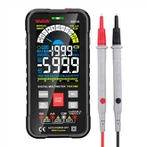
How to use a line multimeter
The multimeter has a beep stop, which means using two probes to measure the same wire. If there is a short circuit, there will be no response. If there is a circuit, there will be a beep sound. Sometimes, when the device itself is grounded poorly and the shell is live, the red probe of the multimeter can be placed on the black label of the shell to directly contact the ground. The strength of the shell leakage current can be measured by connecting it to the circuit in series for the rest of the work.
To check for circuit leakage, a megohmmeter (megger) should be used, as the voltage of the multimeter is lower (9V) and the voltage of the megohmmeter is higher (500V). Because the working voltage of the circuit is 220V, it is difficult to diagnose circuits with insignificant leakage. To use a digital meter to check for circuit leakage, you first need to cut off the power supply, discharge the circuit, and measure it with a resistance level of 2M. The normal display is 1 (infinite).
Measuring whether the circuit is in a connected state can be measured using a multimeter's ohm range. When measuring, it is necessary to select a range where the meter pointer is close to 0 ohms of deflection. If the circuit is in a circuit, one end (A end) of the circuit should be connected to a multimeter (red lead) at 100 ohms, and the black lead should be connected to the other end (B end) of the circuit to be measured. If the measured result is zero, it indicates that the circuit is connected, also known as a path. Only a path can current flow through the circuit; If the multimeter ohmmeter pointer at the A to B end of the circuit is not close to zero ohms, the circuit is already in an open circuit state, and disconnection is called an open circuit or an open circuit.
Measurement of triodes
(1) Measurement steps
Insert the red probe into the V Ω hole and the black probe into the COM hole
Turn the dial to () position
Find the base b of the transistor
Determine the type of transistor (PNP or NPN)
Turn the turntable to hFE position
Insert PNP or NPN jack according to type for testing β
Reading the display screen β value
(2) Attention
e. Determination of pins b and c: The insertion position of the probe is the same as above; Its principle is the same as that of a diode. Assuming that pin A is the base, connect it with a black pen, and the red pen contacts the other two feet separately; If both readings are around 0.7V, then connect the A pin with a red pen and the other two pins with a black pen. If both readings show "1", then the A pin is the base electrode. Otherwise, it needs to be re measured, and this tube is a PNP tube.
So how to determine the collector and emitter? We can use the "HFE" gear to determine: first set the gear to the "HFE" gear, and you can see a row of small sockets next to the gear, which are divided into PNP and NPN tubes for measurement. The tube type has been determined earlier. Insert the base electrode into the corresponding tube type "b" hole, and insert the other two pins into the "c" and "e" holes respectively. At this time, the numerical value can be read, which is β Value; Fix the base again, and switch the other two legs; Compare the two readings, and the pin position with the larger reading corresponds to the surface "c" and "e".