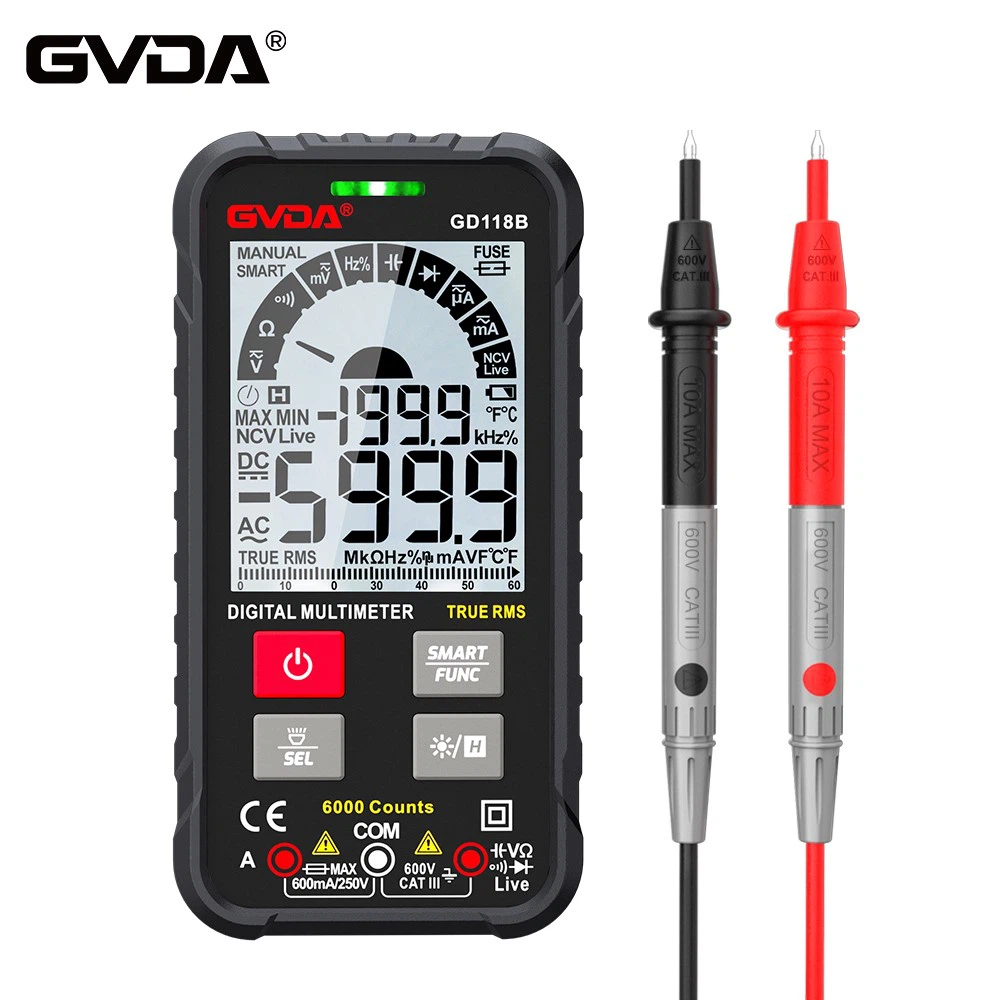
How to use a multimeter to check a line
Use either AC or DC voltage when charging, depending on the circumstance! To find circuit routes and short circuits without dots, use electrical obstacles!
The buzzer block on the multimeter allows you to measure the same wire using two test leads. There won't be any reaction if there is a short circuit. If it's a circuit, a buzzing noise will be heard. You can sometimes use the red test lead of the multimeter to place it on the black mark on the cover when the gadget itself is charged because of inadequate grounding. The strength of the leakage electrical appliance of the shell can be assessed in comparison to direct contact with the ground, allowing for knowledge of it for the remaining work. In order to measure both AC and DC current, it is additionally linked in series to the circuit.
Because the voltage of the megger is 500 volts and the voltage of the multimeter is only 9 volts, you must use a megohmmeter (shaking meter) to determine whether the line is leaking or not. It is challenging to assess a line with no evident leaks because the working voltage of the line is 220 volts. To check for line leakage using a digital meter, turn off the power source first. Then, when the line has been discharged, use the resistance gear and 2M gear to measure; the default display value is 1 (infinite).
You can check the ohm range using a multimeter to see if the line is connected. When measuring, pick a spot where the ammeter's pointer is nearly deflecting 0 ohms. If the line is in the circuit, connect the A end of the line to the multimeter's 100 ohm range (using the red test pen), and the B end of the line to be measured using the black test lead. A connected line is also known as a path if the measured result is zero.Current can only flow down a path, so if the multimeter's pointer for the ohm range meter is not close to zero ohms from the A end to the B end of the line, the line is already disconnected and is considered to be open circuit.
How to use a multimeter to find problems
The multimeter checks electrical faults, generally only two gears are used, one is voltage (including AC and DC voltage) and the other is ohms.
If the device is not working, the first thing you think about is whether the voltage of the device is normal, you need to use the voltage file of the multimeter (choose AC voltage file or DC voltage file, it depends on whether your device is AC device or DC device) to measure. If the control circuit or the secondary circuit is disconnected, if you are familiar with the schematic diagram, you have to use the voltage file to measure whether the voltage at a certain place is normal. If you are sure that the voltage at this place should not be there, there is instead, and what should be there is not. , it means that there is a disconnection or poor contact. In order to be more sure whether there is a problem here, you have to disconnect the power supply of the device at this time, and use the ohm file of the multimeter to determine whether the wire is indeed disconnected in order to troubleshoot. Roughly, it mainly depends on your familiarity with the equipment and the accumulation of experience at work.