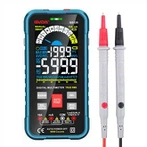
How to use a multimeter to check whether a line is short-circuited or grounded?
If you want to check whether there is a short circuit in the line. First, power off the line, then open each load switch, and use the ohmmeter of a multimeter to check the resistance between the two wires. Normally, the larger the resistance, the better. If you want to determine whether the line is grounded, you can use the ohm block of the multimeter. To measure the resistance of each line to ground. The bigger the better. It should be pointed out that using a multimeter to measure whether a line is short-circuited or grounded is inaccurate. It shouldn't be. If the grounding or short-circuit resistance is very small, it can be detected with a multimeter. If the resistance is slightly larger, it can be detected. A multimeter cannot check it, as it is in a 380V low-voltage circuit. A 500V megger should be used for measurement, whether between lines or to ground. Both should be above 0.38 megohms. Otherwise it is unqualified.
First, the live and neutral lines need to be separated.
Ground wire: Set the multimeter to the AC voltage range, and the range is higher than 220V. Insert the red test lead into the voltage hole, leave the black test lead unplugged, then insert the red test lead into one of the socket jacks and observe the reading.
The one with the largest reading is the live wire, the one with the smaller reading is the neutral wire, and the one with basically no movement is the ground wire.
If two readings are small and one reading is large, it means that the ground wire is not connected to the ground, and the ground wire is also connected to the neutral wire. There is no need to measure in the second step.
Turn the multimeter to the "short circuit" test function (if not, turn on the resistance test), connect the red and black test leads to the circuit ground and the mains ground respectively. If the test result is a short circuit, or the resistance is extremely small, the line is grounded. , and vice versa.
Check leakage and grounding, and set the multimeter to 200M. For example, when measuring the insulation of equipment, connect one end of the test lead to the equipment shell or ground wire, and the other end of the test lead to the line. When measuring insulation, do not touch the test leads with your hands to prevent measurement errors.
Adjust the resistance range of the multimeter to 20K or 200K, turn off the main power supply and load power, use a multimeter to connect one test lead to the live wire and one to the ground wire to check the resistance value, then connect one test lead to the neutral wire and one to the ground wire, watch For the two resistance values, if one appears to be above 7.3, or above 14., it means that the live wire or neutral wire connected to the resistance value is leaking.
The essence of voltage is potential difference. As long as the voltage between the two lines is 0, it can be measured using the resistance scale:
1. Suppose you want to measure whether there is a short circuit between line A and line B. There may be a voltage between line A and line B to the neutral line (for example, 220 volts). The potentials on their lines are potential A and potential B respectively. Many The first thing that people think of is that if you measure directly with the resistance level, you must cut off the power supply on line A and line B before measuring. This idea is not wrong, it can only be said to be too conservative.
2. Directly set the multimeter to the AC voltage range, select the highest range, such as AC1000 volts, etc., and then use the AC voltage range of the multimeter to measure line A and line B. If there is a relatively high voltage between the two lines (for example, 200 volts) volts), it can be proved that the potential A and the potential B are not equal, that is to say, there is a voltage difference between the potential A and the potential B. The two lines are not of equal potential, and the two lines are not shorted together.
3. If line A and line B are measured using the AC voltage range and there is no voltage, for the sake of assurance, use the DC voltage range such as the 1000 volt range to measure between them and confirm that there is no DC voltage. This can prove the potential A and potential B. Equal, please note that being equal does not mean that they have no voltage to the neutral line N. For example, line A and line B are both 220 volts to the neutral line N, but the voltage between them is also 0 volts. At this time, you can use the smallest resistance level. Measure the resistance between these two lines. If it is close to 0 ohms, it means that the two lines are short-circuited together.
4. As for measuring whether it is grounded, you can simply use the above method to measure. The idea is to understand the ground wire as an ordinary wire. But to generally measure whether it touches the ground, you can use a megger to measure the insulation resistance (generally insulated is 5 megohms). At this time, you need to cut off the power to measure.