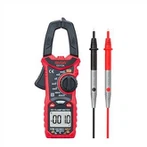
How to measure leakage voltage and distinguish live and neutral wires with a multimeter
How to measure the leakage voltage using a multimeter or electronic multimeter. Nowadays, most of the electricity used by enterprises and individual households is 220 volt AC. The center line is connected to the ground. At the same time, the protective ground wire is also connected to the earth. Therefore, the center line (working line) and the protective ground are set separately, so two types of ground wires also exist. Potential difference, so this potential difference can only be close to 36 volts. The voltage is too low to distinguish between the working line and the protective earth gas as the same line. The protective earth gas cannot provide leakage protection and is very dangerous.
If the shell of the equipment used leaks electricity, leakage voltage will be generated, and it will be dangerous if the voltage exceeds 36 volts AC.
Therefore, you should usually pay attention to the insulation and leakage of equipment.
To know and measure the leakage voltage, the method is very simple and practical, but the method is very crude. As long as you have a multimeter (AC scale from high to low), place the two meter rods on a humid area or water pipe with one hand, and place the other hand on the case. If the voltage exceeds 36 volts, it is a dangerous voltage.
In addition, if the other end of the high-voltage DC power supply is not directly connected to the ground, there will be no leakage voltage to the ground. But be careful, it is also very dangerous to touch the second-line voltage with your hands.
It is the same principle to distinguish the live line or the working line (center line). The watch stick is placed on a wet ground or water pipe with one hand. Connect the other meter stick to the live wire at will, and you will be able to tell immediately if there is voltage.
Use the simplest method, measure the neutral wire, live wire and ground wire, turn on the switch, set the digital multimeter to AC, and the mechanical multimeter to ~. The voltage setting should be higher than the voltage being measured, for example, when measuring 220 volts, set 500 volts or 750 volts. , one end is grounded, such as a sewer pipe or an indoor total zero. It is okay to tie it to the wall in both places, but outside the tile wall. At this time, the voltage is different. Because the degree of dryness and humidity of the wall is different, the voltage will also be different. As long as it reads a few dozen volts or more, this wire is the live wire. Open the gate, use the multimeter to have the highest resistance setting, the pointer type is 10K or 100K, the digital type is also the highest setting, the one with the smallest reading is the ground wire, and the one with a slightly larger resistance is the neutral wire. When a friend's house was being renovated, the power supply tripped after the completion. The decorator called their electrician for two days but couldn't find the fault. The electrician had to call the electrician in the village. The electrician in the village couldn't find the fault for several days. Later, he found out that several The sockets in various places have mixed zero and live wires. The mixed sockets are low and difficult to operate, which causes the leakage appliance to trip.
As for leakage, if it is a household appliance, use a 10K multimeter to measure the power-receiving part of the appliance. If the resistance is very small, a few ohms or more than ten ohms, then the insulation of the appliance is damaged or aged, or it is exposed to moisture, etc. There will be leakage. Household appliances such as Do not use a megometer to test TVs, computers, stereos, etc. Otherwise, after the test is completed, your equipment will also be damaged, because the voltage of the megometer can reach thousands of volts, which will damage the components of electronic equipment. If there is a leakage in the home, you can first use a multimeter to measure the electrical resistance. Experience is that it is almost impossible to detect when it is far away from the fault point, that is, the resistance value is very large, and sometimes it will not move. The closer to the fault point, the higher the resistance value. Small, this operation is much easier to use than a rocker meter. If the leakage is very small, you have to use a megger to measure it. In rural areas, insert an iron rod into the ground outdoors and connect it to a line. The upstairs is at the main point or ground line, and the other side is detected by the disconnection method. Since the floor is The upper sockets are all connected in parallel, and the segmented detection and elimination method is adopted. That is, after disconnecting from the middle house, measure in two ways. This is the simplest method of detection.