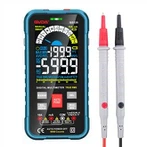
How to use a multimeter to detect the cause of the circuit breaker trip
How to use a multimeter to detect the cause of the circuit breaker trip
There are usually three reasons for the air switch to trip. Short circuit, overload and malfunction.
There is no need to measure the short circuit, and there are obvious and even huge sound and light phenomena. For tripping caused by this reason, as long as the cause of the short circuit is eliminated, then check whether the contacts of the air switch are burned by the short circuit current. Disconnect the upper-level power supply, so that the air switch is in an absolutely uncharged state, close the air switch, and use a multimeter to measure the three-phase incoming and outgoing wiring terminals of the switch. If the conduction is good, you can try it with power on. If the phase is missing, needless to say, replace the air switch.
In the air switch with a short circuit, the terminals may be broken down. You can use a megger to measure the insulation resistance between the terminals (you can also use a multimeter with a gear above 20K to measure, and remove the inlets on both sides of the air switch. line and outlet). If you start shaking the watch, the pointer of the watch will deflect to the right quickly, indicating that the interphase insulation of the air switch has been broken down and cannot be used. If the insulation resistance is very large, more than a few megohms, you can try it with electricity.
The procedure of power-on trial is as mentioned above. Disconnect the front power supply, turn on the overhauled air switch, and then turn on the front power switch. If the power supply is normal and there is no abnormal sound and smell, the air switch can continue to be used. .
overload. Overload is one of the causes of frequent tripping of the air switch. If you touch the air switch for overload tripping by hand, you will usually feel that the housing is relatively hot, even hot. This will cause the thermal element inside the air switch to produce a protective action.
Use the AC current range of the multimeter to measure the working current of the air switch. If the working current exceeds the rated current of the air switch and continues to run, you should replace the air switch with a larger level according to the actual working current.
Misoperation. When the incoming and outgoing wires of the air switch are aluminum wires, it is easy to oxidize with the copper terminals of the air switch, causing heat at the terminals. The thermal protection device inside the air switch is deformed by heat and produces a protective action. This is a typical misoperation. This problem can be solved as long as the copper-aluminum terminal is pressed on the aluminum wire and tightly combined with the terminal of the air switch.
How to use a multimeter to measure the line, know that the automatic air switch trip is caused by a short circuit
Disconnect the air switch, turn off all the light switches (if you cannot determine the direction in which the light switch is turned on, you can also remove all the lights to avoid misjudgment caused by the resistance of the light), and turn off all the lights on the socket. Disengage the load, unplug all the plugs on the socket; use the resistance gear of the multimeter, and insert it into the jack of the socket (make sure that the air switch is in the off state, otherwise it will cause a short circuit accident, cause personal injury and damage to the multimeter), if If the reading is zero or the buzzer of the digital multimeter sounds, there is a fault in the line; according to the direction of the line, the wires in the junction box can be disconnected step by step. This junction box and the previous junction box are on this line; when it needs to be pointed out, when using this method to search, it is necessary to have a better understanding of the direction of the line and know where the upper junction box of the measurement point is.
How to check the circuit trip with a multimeter
If it trips, it will leak electricity.
Short circuit: put the multimeter in the ohm range R×10. Disconnect all the loops in the circuit and connect them to both ends of the line to be tested. If the resistance is 0, it means a short circuit.
Open circuit: the circuit is disconnected, the red test lead of the multimeter is connected to the "+" pole of the power supply, and the black test lead is connected to the "-" pole of the power supply. If the indication is also the power supply voltage, it means that the circuit from these points to the "-" pole of the power supply has no open circuit fault.
Leakage: Line leakage is difficult to measure, but you can measure the resistance of the line to the ground. If the electrical appliance leaks electricity, the neutral or live wire will generally communicate with the casing (the casing that has been grounded) or have poor insulation. It can be measured with a resistance file.