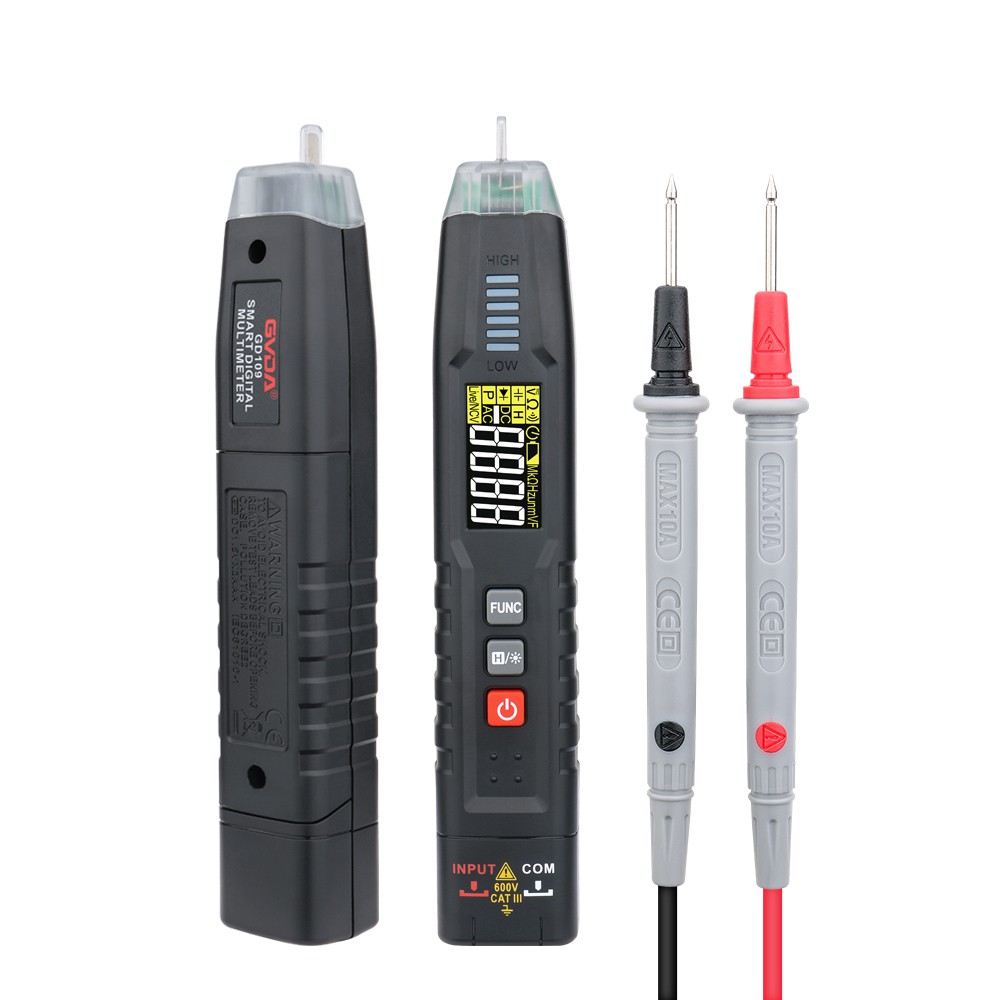
How to use a multimeter to measure short circuit, open circuit, short circuit
Using ohm x1 gear, measure the two ends of the circuit. If the resistance value is close to zero, it is a short circuit. If there is a certain amount of resistance value (depending on the load in the circuit), it is not a short circuit. When the voltage is constant, the smaller the resistance value, the greater the current flowing through the circuit. Measure the two ends of the circuit using the 1k or 10k ohm range. If the resistance is infinite, it is an open circuit
The basic principle of a multimeter is to use a sensitive magneto electric DC ammeter (microampere meter) as the meter head.
When a small current passes through the meter, there will be a current indication. But the meter head cannot pass high currents, so it is necessary to shunt or reduce the voltage by connecting some resistors in parallel or series on the meter head, in order to measure the current, voltage, and resistance in the circuit.
The measurement process of a digital multimeter is converted into a DC voltage signal by a conversion circuit, and then the voltage analog signal is converted into a digital signal by an analog-to-digital (A/D) converter. Then, it is counted by an electronic counter, and finally the measurement result is displayed directly on the display screen in digital form.
The function of measuring voltage, current, and resistance with a multimeter is achieved through the conversion circuit, while the measurement of current and resistance is based on voltage measurement. In other words, a digital multimeter is an extension of a digital DC voltmeter.
The A/D converter of the digital DC voltmeter converts the continuously changing analog voltage into a digital value, which is then counted by an electronic counter to obtain the measurement result. The decoding display circuit then displays the measurement result. The logic control circuit coordinates the operation of the control circuit and completes the entire measurement process in sequence under the action of the clock.
principle:
1. The reading accuracy of pointer meters is poor, but the process of pointer oscillation is relatively intuitive, and the amplitude of its oscillation speed can sometimes objectively reflect the size of the measured object (such as the slight jitter of the TV data bus (SDL) when transmitting data); The reading on the digital meter is intuitive, but the process of numerical changes appears chaotic and difficult to observe.
2. There are usually two batteries inside a pointer meter, one with a low voltage of 1.5V and the other with a high voltage of 9V or 15V. The black probe is the positive terminal relative to the red probe. A 6V or 9V battery is commonly used for digital watches. In the resistance range, the output current of the pointer meter is much larger than that of the digital meter. Using the R × 1 Ω range can make the speaker make a loud "click" sound, and using the R × 10k Ω range can even light up the light-emitting diode (LED).
3. In the voltage range, the internal resistance of the pointer meter is relatively small compared to the digital meter, and the measurement accuracy is relatively poor. In some high-voltage microcurrent situations, it is even impossible to measure accurately because its internal resistance can affect the tested circuit (for example, when measuring the acceleration voltage of a TV cathode ray tube, the measured value may be much lower than the actual value). The internal resistance of the voltage range of a digital meter is very high, at least in the megaohm range, and has little impact on the tested circuit. However, the extremely high output impedance makes it susceptible to the influence of induced voltage, and the data measured in some situations with strong electromagnetic interference may be false.