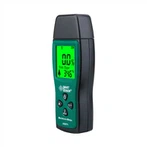
How to use a multimeter to measure the short circuit, open circuit and short circuit of the line
Use the ohm x1 file to measure the two ends of the line. If the resistance is close to zero, it is a short circuit. If there is a certain amount of resistance (depending on the load in the line), it is not a short circuit. When the voltage is constant, the smaller the resistance, the more current flow. The greater the current flowing through the line. Use the ohm 1k or 10k file to measure the two ends of the line. If the resistance is infinite, it is an open circuit.
Extended information:
The basic principle of the multimeter is to use a sensitive magnetoelectric DC ammeter (microampere meter) as the meter head.
When a small current passes through the meter head, there will be a current indication. However, the meter head cannot pass a large current, so some resistors must be connected in parallel or in series on the meter head to shunt or lower the voltage, so as to measure the current, voltage and resistance in the circuit.
The measurement process of the digital multimeter converts the measured value into a DC voltage signal by the conversion circuit, and then converts the voltage analog quantity into a digital quantity by the analog/digital (A/D) converter, then counts through the electronic counter, and finally uses the digital measurement result displayed directly on the display.
The function of the multimeter to measure voltage, current and resistance is realized through the conversion circuit part, and the measurement of current and resistance is based on the measurement of voltage, that is to say, the digital multimeter is expanded on the basis of the digital DC voltmeter.
The A/D converter of the digital DC voltmeter converts the analog voltage quantity that changes continuously with time into a digital quantity, and then the digital quantity is counted by the electronic counter to obtain the measurement result, and then the measurement result is displayed by the decoding display circuit. The logic control circuit controls the coordinated work of the circuit, and completes the entire measurement process in sequence under the action of the clock.
in principle:
1. The reading accuracy of the pointer meter is poor, but the process of the pointer swing is more intuitive, and its swing speed range can sometimes objectively reflect the size of the measured (such as measuring the slight jitter); the reading of the digital meter is intuitive, but the process of digital change looks messy and not easy to watch.
2. There are generally two batteries in the pointer meter, one is low voltage 1.5V, the other is high voltage 9V or 15V, and the black test lead is positive terminal relative to the red test lead. Digital meters usually use a 6V or 9V battery. In the resistance mode, the output current of the test pen of the pointer meter is much larger than that of the digital meter. The loudspeaker can make a loud "da" sound with the R×1Ω gear, and the light-emitting diode (LED) can even be lit with the R×10kΩ gear.
3. In the voltage range, the internal resistance of the pointer meter is relatively small compared with the digital meter, and the measurement accuracy is relatively poor. Some occasions with high voltage and micro current cannot even be measured accurately, because its internal resistance will affect the circuit under test (for example, when measuring the acceleration stage voltage of a TV picture tube, the measured value will be much lower than the actual value). The internal resistance of the voltage range of the digital meter is very large, at least in the megohm level, and has little effect on the circuit under test. However, the extremely high output impedance makes it susceptible to the influence of induced voltage, and the measured data may be false in some occasions with strong electromagnetic interference.
4. In short, pointer meters are suitable for the measurement of analog circuits with relatively high current and high voltage, such as TV sets and audio amplifiers. It is suitable for digital meters in the measurement of low-voltage and low-current digital circuits, such as BP machines, mobile phones, etc. It is not absolute, and pointer tables and digital tables can be selected according to the situation.