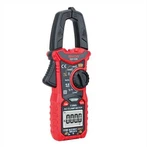
How to use clamp ammeter correctly
Before measurement, it is necessary to check whether the rubber insulation of the clamp iron core is intact and undamaged. The jaws should be clean, rust free, and have no obvious gaps when closed.
When measuring with a clamp ammeter, it is necessary to first estimate the magnitude of the measured current and select an appropriate range. If it is impossible to estimate, you can first choose a larger range and then gradually reduce it to the appropriate gear. When shifting the range gear, it must be done without charging or with the jaws open to avoid damaging the instrument.
When measuring, the tested wire should be placed in the middle of the clamp as much as possible. If there is any noise on the joint surface of the clamp, it should be opened and closed again. If there is still noise, the joint surface should be treated to ensure accurate reading. Additionally, it is not allowed to clamp two wires at the same time.
When measuring currents below 5A, in order to obtain more accurate readings, if conditions permit, the wire can be wound a few more times and placed in the clamp for measurement. The actual current value should be the instrument reading divided by the number of wires placed in the clamp.
Before and after each measurement of the clamp ammeter, the switch for adjusting the current range should be placed at the zero position to avoid damaging the instrument due to measuring without selecting the range in the next use.
A clamp ammeter is different from a regular ammeter in that it consists of a current transformer and an ammeter. Load current can be measured without disconnecting the circuit. But only for use when the voltage of the tested line does not exceed 500V.