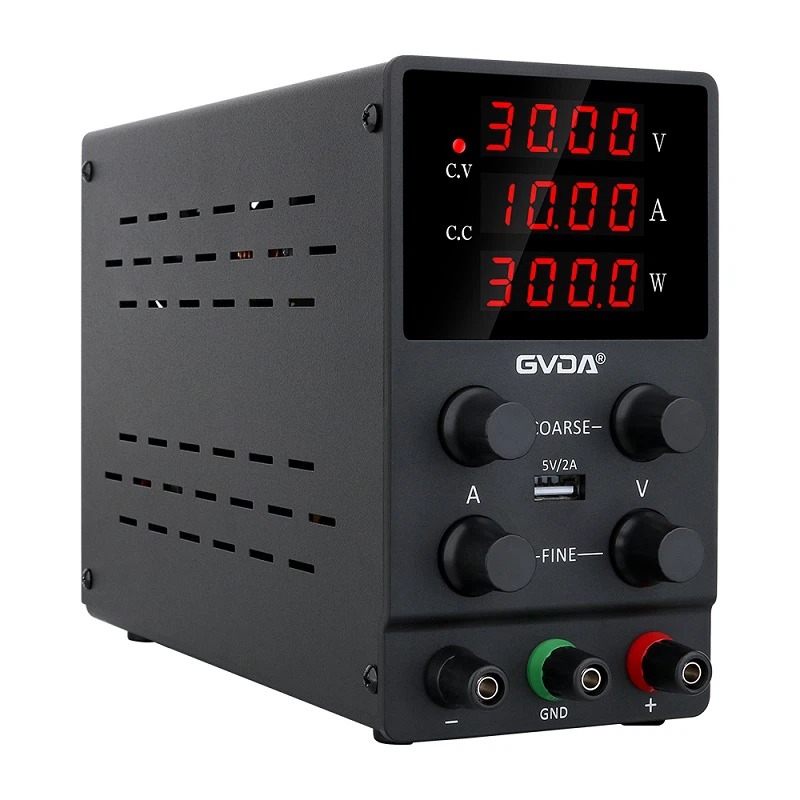
How to use constant voltage constant current high precision DC stabilized power supply
Constant voltage constant current high-precision DC regulated power supply is constant voltage (CV), constant current (CC), output voltage 0~30V adjustable, output load current 0~3A adjustable power supply equipment. Its working characteristic is constant voltage/constant current automatic conversion, which can continuously change between constant voltage and constant current state with the change of load, and the intersection point between constant voltage and constant current mode is called the conversion point. The rechargeable battery can be charged by using the constant current characteristic, which is very convenient to use.
Working principle of constant voltage constant current high precision DC regulated power supply
The whole machine is divided into four parts: series DC stabilized power supply, including adjustment amplifier and constant voltage circuit; constant current regulation and constant voltage constant current conversion display part; reference stabilized voltage power supply; transformer secondary AC voltage automatic adjustment circuit.
1. Series DC stabilized power supply and constant voltage circuit. It is mainly composed of adjustment tubes T1, T2, T10, T11, op amp IC1, p1, p2 voltage adjustment potentiometer, and reference voltage to form a constant voltage circuit, which controls the base voltage of T2, changes the conduction degree of the adjustment tube, and ensures the stability of the voltage regulator circuit. normal work. Here, p1 and p2 are used as coarse adjustment and fine adjustment potentiometers to adjust the voltage, and the non-inverting terminal of IC1 is connected to the reference voltage and the adjustment voltage, and compared with the sampling voltage at the inverting terminal to change the current of the adjustment tube.
2. Constant current circuit - also known as current limiting circuit. That is, when adjusted to the predetermined current limit, the output current remains constant, and the output voltage decreases proportionally as the load further increases. The constant current circuit is composed of operational amplifier IC2 and sampling resistor 0.15Ω, plus a constant voltage and constant current conversion display circuit. The non-inverting end of IC2 gets the reference voltage from the p3 current adjustment potentiometer and the reference power adjustment W1, and the inverting end is connected to the front end of the sampling resistor 0.15Ω through a resistance of 1kΩ. When the sampling voltage is greater than the reference voltage, the output voltage of IC2 drops, so that the Vb of T2 drops, and the output voltage decreases, but the output current remains unchanged, achieving the purpose of current limiting. At constant voltage, T8 is on and T9 is off, so the green light of constant voltage (CV) is on, and the red light of constant current (CC) is off, because the output of IC2 is high level at constant voltage, and the voltage regulator DZ (6V) makes T8 On, the green light is on. When the current limiting protection works, the output of IC2 is 0. At this time, the Vb of T2 drops to 0 through the diode voltage, so that the adjustment tube is cut off.
3. Reference regulated power supply. Composed of TL431 and 78L12, T3. TL431 is not only used as a standard voltage, but also responsible for amplifying the error voltage and controlling the T3 tube. The internal reference voltage of TL431 is 2.5V, the sampling voltage is actually compared with the 2.5V reference voltage of TL431, and the cathode voltage of TL431 is changed to adjust the conduction of T3. In addition, the base voltage of T3 is stabilized by 78L12 and then passed through a resistance of 1kΩ to the base to keep the output +15V stable. The output +15V is mainly used for IC1 and IC2 integrated operational amplifier power supply and reference voltage for constant voltage and constant current circuits. Reference voltage for AC voltage switching circuits. +6V is connected to the output positive pole of the main regulated power supply.
It can be seen that the high precision of the TpR-3003 DC regulated power supply mainly uses the reference power supply composed of double high-precision regulated voltage.
4. The output +10V and +20V are automatically switched. The base of T6 is connected to the reference voltage through a 45kΩ resistor, and the reference voltage is provided by the reference voltage, while the other base is connected to the output cathode of the total power supply through a 18kΩ resistor and a series diode for sampling. When the output voltage is lower than 10V, T6 is turned on, T7 is turned off, the relay J2 is released, and the normally closed contact is connected to the input voltage at the low gear of AC 14V. When the output DC voltage reaches 10v, the base of T6 has a negative voltage and turns off, so T7 is turned on, the relay J2 is closed, and the normally closed contact is connected at the high gear of 24. When the total output power of the Zener tube reaches +20V, T5 is cut off, T4 is turned on, and J1 is closed, so that the normally open contact of J1 is connected, and the input voltage of the regulator tube is switched to the third high gear 32. TpR adjustable regulated power supply always guarantees a certain voltage difference when adjusting the voltage, which is mainly obtained by automatically adjusting the AC voltage.
How to use constant voltage constant current high precision DC stabilized power supply
Before use, the instrument must be calibrated for current limitation. After starting up, adjust the voltage to the required voltage value, and then turn the power adjustment knob until the constant current (CC) indicator lights up, indicating that the machine is in a constant current state. Temporarily short-circuit the + and - terminals of the power output with a short-circuit wire, adjust the current knob to the required current limit value, do not change the position of the current knob after setting, and remove the short-circuit wire to enter the working state.
Faults and Maintenance of Constant Voltage, Constant Current and High Accuracy DC Stabilized Power Supply
1. The voltage adjustment knob does not work, mainly because the 6V voltage regulator tube in the reference regulated power supply circuit breaks down or disconnects, causing the voltage regulation potentiometer to have no sampling voltage. The 6V Zener tube breaks down, the voltage indication reaches the maximum, and the Zener tube disconnects the voltage indication to the minimum.
2. The current regulator does not work when the + and - terminals of the power supply are short-circuited. At this time, you should first check whether the IC2 operational amplifier is normal, and then check the reference voltage. In this regulated power supply, the reference voltage is the most important and should be the primary inspection object. Generally, it is caused by the desoldering of the W1 trimmer potentiometer on the printed board. If the p3 potentiometer is desoldered, the current output will reach the maximum value.
3. Turn the potentiometer p3 to the left to the bottom, and it is in a constant current state. The red indicator light CC should be on, and the green indicator light CC should be off. At this time, the voltage indicator is zero. If the voltage indicator is less than zero, it means that there is a problem with the zero adjustment of the IC2 operational amplifier integrated block. Problem, if IC2 operational amplifier pin ① and pin ④ are short-circuited, the voltage display will be zero, which is mainly caused by replacing IC2 operational amplifier with a new operational amplifier after damage.