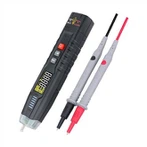
How to use the multimeter correctly
1. Selection of measurement type: Before measurement, first select the type according to the object to be measured and turn the switch to the corresponding position. The range conversion switch must be set to the position to be measured, and it cannot be set wrongly. If you mistakenly select the current or resistance position when measuring voltage, the meter will be damaged.
2. Selection of measurement limit: The measurement limit should be selected according to the approximate range to be measured.
3. Measurement connection: when measuring voltage, connect the multimeter to the branch circuit under test in parallel, and connect the multimeter in series to the branch circuit under test when measuring current. Pay special attention to the polarity of the meter when measuring DC power. The red test lead is connected to the positive pole, and the black test lead is connected to the negative pole.
4. The correct use of the ohm file:
⑴ Choose an appropriate magnification and try to make the pointer indicate the part of the scale close to the center of the ohm.
⑵ "Zero adjustment" should be done before measurement.
⑶ Do not measure resistance with power on.
⑷ The measured object cannot have a parallel branch.
⑸ Zero-ohm adjustment should be done quickly, and care should be taken not to short-circuit the test rod when not zero-adjusting, so as not to waste dry batteries.
5. Correct reading: There are multiple scales on the dial, which should be read according to different measured objects. When measuring direct current, read the "DC" or "one" scale, and when measuring alternating current, read "AC" or "~" scale, and the scale marked with "Ω" is used when measuring resistance. When reading, the type of scale should be distinguished first, and the reading from the corresponding scale should not be confused.
6. Matters needing attention:
(1) Before using the multimeter, check whether the hands of the multimeter are at the zero position. If it is not at the zero position, use a small screwdriver to adjust the zero adjuster on the cover of the meter to perform "mechanical zero adjustment" so that the hands of the multimeter are at the zero position. Do not touch the metal part of the test lead with your hands when measuring.
(2) Pay attention to personal safety when measuring high voltage or high current. The test lead should be inserted into the corresponding jack, and the range switch should be turned to the corresponding range position. Before the measurement, the multimeter should be placed on the insulating support, the circuit under test should be cut off from the power supply, if there is a large capacitor in the circuit, the capacitor should be short-circuited and discharged, the test leads should be fixed on the circuit under test, and then the power supply should be turned on for measurement. Be careful not to toggle the transfer switch with power on.
(3) When measuring the DC voltage superimposed AC signal, the highest withstand voltage value of the instrument transfer switch should be considered.
⑷ After using the multimeter, generally the switch should be turned to the highest AC voltage. When the multimeter is not in use for a long time, the battery should be taken out to prevent battery leakage from corroding and damaging the internal parts of the multimeter.