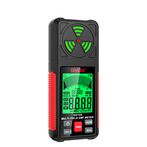
Ideal Usage Times for Pin-Type and Pinless Moisture Meters
The needle type moisture meter uses the principle of resistance to measure the moisture content in various materials. Since water is a conductor, materials such as wood, cotton, gypsum, and hay are all resistors, and the easier the current flows through the material, the wetter it becomes. For the sake of precision, it is important to ensure that the needle instrument is calibrated for the specific material being tested - as different materials have different inherent current resistances.
On the other hand, needle free hygrometers use electromagnetic radio frequency to "scan" material samples to determine the presence of water. The fluctuation of electromagnetic waves is used to measure the amount of water in a sample. The accuracy of the needle free moisture meter is affected by the specific gravity (SG) of the scanned material, so it is necessary to calibrate the instrument for the SG value of the material. Specific gravity is a measure of the relative density of a material compared to another material (usually water).
Both needle and needle less hygrometers have their unique advantages and disadvantages, which may make them more or less suitable for specific humidity testing situations. When should a needle type moisture meter be used and when should a needle free moisture meter be used? The following is a broad scenario where one hygrometer may be better than another.
Needle free moisture meters are adept at quickly and effectively testing large areas of moisture in structures. Just push the scanning board into the floor, read it, lift it up, and repeat the scan in another position. Scan the board once to inspect a large area, and each inspection only takes a few seconds. This allows users to quickly scan very large areas of the structure with relative ease.
On the other hand, a needle hygrometer can only check for moisture in a small area between the contact needles. In addition, they need to delve into the tested material to obtain comprehensive reading. This usually means that greater force is required to penetrate tougher materials, increasing the risk of strain and damage to the pin. A smaller testing area and additional effort can help increase the time and labor cost for measuring moisture over a large area.
Needle free hygrometers require complete contact with solid surfaces to provide accurate readings. If the scanning board cannot be completely placed flat on the tested material, the accuracy of the needle less hygrometer will be affected. In addition, if the scanned material is loosely packaged (such as for insulation or hay), the instrument may ultimately test the moisture content of the air between the fibers of the material.
On the other hand, a needle hygrometer can be easily used to test materials that are loosely packed or have uneven surfaces. The important thing is the current in the tested material - as long as there is a path for current to flow from one pin to another, the test can be completed. However, in order to test the moisture content in fiberglass insulation materials, hay bales, etc., specialized electrodes may be required.