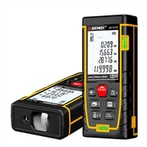
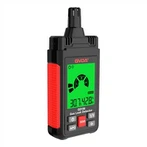
unit of light meter
Many customers will say, I want to buy an illuminance meter, and naturally they will ask what the illuminance meter unit is! Now let’s briefly introduce illuminance. Illuminance is a unit that reflects light intensity. Its physical meaning is the luminous flux irradiated on a unit area. The unit of illuminance is the number of lumens (Lm) per square meter, also called Lux (Lux): 1Lux=1Lm/m2. It can be seen from the above formula that Lm is a unit of luminous flux, which is defined as the amount of light radiated by pure platinum within a solid angle of 1 steradian over a surface area of 1/60 square meters at the melting temperature (about 1770 °C).
The above explanation of the luminance unit seems to be very theoretical, and it is generally difficult to understand. In order to have a more perceptual understanding of the amount of contrast, for example, a 100W incandescent lamp emits a total luminous flux of about 1200Lm. If it is assumed that the luminous flux is evenly distributed on the hemisphere, the distance from the light source The illuminance value at 1m and 5m can be obtained according to the following steps: The area of the hemisphere with a radius of 1m is 2π×12=6.28 m2, and the illuminance value at 1m from the light source is: 1200Lm/6.28 m2=191Lux. Similarly, the area of a hemisphere with a radius of 5m is: 2π×52=157 m2, and the illuminance value at a distance of 5m from the light source is: 1200Lm/157 m2=7.64Lux.
General situation: in summer, it is about 100000LUX in the sun; on a cloudy day, the outdoor illuminance is 10000LUX; the indoor fluorescent light illuminance is 100LUX; The illuminance is 10LUX; the illuminance of street lamps at night is 0.1LUX; the illuminance of candles (at a distance of 20cm) is 10-15LUX.
Speaking of which, everyone should have a more perceptual understanding of the unit of the illuminance meter. In fact, the illuminance meter is widely used in factories, schools, libraries, commercial buildings, hotels, commercial exhibition halls, laboratories, computer rooms, etc. , These places need to use the illuminance meter. It can be exaggerated to say that as long as there is bright light, the illuminance meter may be used to measure the current illuminance.
Sunny day: 30000~300000LUX production workshop 10~500LUX
Cloudy day: 3000LUX Office 30~50LUX
Sunrise and sunset: 300LUX restaurant 10~30LUX
Full Moon: 0.3~0.03LUX Corridor 5~10LUX
Starlight: 0.0002~0.00002LUX Parking lot 1~5LUX
Dark night: 0.003~0.0007LUX
Under normal circumstances, we are more comfortable in an illumination environment of about 250-750LUX. Too high or too much illumination can also hurt human eyes. The most direct one is myopia, and most of myopic eyes are in very low illumination. Reading for a long time or overuse of the eyes in the environment is also worthy of our attention.
Illuminance meter unit and application conditions
Scope of application of light meter
Illumination is closely related to people's lives. For example, adequate light can prevent people from accidents. On the contrary, too dim light can cause human fatigue far more than the eyes themselves. Therefore, uncomfortable or poor lighting conditions are one of the main causes of accidents and fatigue. Existing statistics show that about 30% of all occupational labor accidents are directly or indirectly caused by insufficient light. The lighting of the stadium (hall) is very strict. Too strong or too dark light will affect the effect of the game.
So, what about the hygiene of indoor contrasts where people live? Illuminance is a very important indicator in hygiene. Light refers to the electromagnetic radiation that can cause the human eye to feel bright, and the perception that can be produced when the light enters the eye is called vision. The light that people see refers to visible light, and its wavelength ranges from 380 to 760 nm (nanometers).
At present, lighting can be divided into two categories: natural lighting and artificial lighting. Natural lighting refers to the natural illuminance of indoor and regional areas, including direct sunlight scattered light and reflected light from surrounding objects, which are commonly expressed by daylighting coefficient and natural illuminance. The daylighting coefficient refers to the ratio of the effective area of the daylighting opening to the indoor floor area. The daylighting coefficient of a general residence is between 1/5 and 1/15, and the living area ratio is between 1/8 and 1/10 (window area/indoor floor area). The natural illuminance coefficient is used to evaluate the illuminance level of natural light. It reflects the relationship between indoor and outdoor light exposure. It also reflects the local light climate (the sum of natural light energy and solar illuminance indicators for the climate).
In order to ensure that people live in suitable light, my country has formulated hygienic standards for indoor (including public places) illumination. For example, the illuminance hygiene standard of shopping malls (shops) in public places is ≥100Lx; the hygiene standard of the countertop illumination of libraries, museums, art galleries and exhibition halls is ≥100Lx; the illumination hygiene standard of public bathrooms is ≥50Lx; bathrooms (showers, pools, tub baths) ≥ 30Lx, sauna ≥ 30Lx. Foreign standards for indoor illuminance, such as Germany recommends several rated light intensities, 300Lx for office including paperwork area, 750Lx for typing and drawing work; in factories, the illuminance requirements for visual work on production lines are 1000Lx; 200Lx for hotels and public rooms; 200Lx for reception points and cashiers; 1500-2000Lx for shop windows; 150-200Lx for hospital wards and 500Lx for emergency medical areas; 400-700Lx for schools and classrooms; 400-700Lx for schools and classrooms; Gym is 300Lx etc.
For the measurement method of illuminance, it is generally measured with an illuminometer. The illuminometer can measure the intensity of different wavelengths (such as the measurement of visible light and ultraviolet wavelengths), and can provide people with accurate measurement results.
In a word, illuminance and human health, especially the health of eyes, have extremely important hygiene significance. The correct indoor light source and good living habits can make you have a pair of bright and healthy eyes, which is your lifelong happiness.
The above is the application of illuminance meters in life. In fact, illuminance meters are also widely used in various industries and have been well received.
Illuminance meter requirements for application
● Small size and light weight (Compact Size, Light Weight)
Opportunities for illuminance meters to be used are very extensive, and they are often used in different places. Therefore, portable illuminance meters with small size and light weight are the prerequisites for illuminance meters.
● Accuracy﹝Accuracy﹞
Whether the illuminance meter is good or bad is closely related to its accuracy. Of course, it is also closely related to its price. Therefore, it is necessary to buy a high-accuracy illuminometer at a reasonable price. Generally, the error should not exceed ±15%.
● Color Compensation ﹝Color Compensation﹞
The types of light sources are all-encompassing, some prefer red high-pressure lamps with longer wavelengths, or blue-violet lamps with shorter wavelengths such as Daylight fluorescent lamps; there are also more evenly distributed series such as incandescent bulbs, the same illuminometer may have a slightly different sensitivity to different wavelengths. Different, so appropriate compensation is necessary.
● Cosine Compensation﹝Cosine Compensation﹞
We all know that the brightness of the illuminated surface is related to the incident angle of the light source. For the same reason, when measuring with an illuminometer, the sensor (Sensor) and the incident angle of the light source will naturally affect the reading value of the illuminometer. So whether a good illuminometer has the function of cosine compensation cannot be ignored.