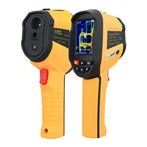
Infrared technology for portable infrared thermometry
Portable infrared thermometer of infrared technology and its principle of unobjectionable understanding of its remote temperature measurement. When the temperature measurement by infrared thermometer, the infrared energy emitted by the object under test, through the optical system of the infrared thermometer in the detector is converted to an electrical signal, the signal temperature readings are displayed, there are several determinants of temperature measurement of the important factors, the most important factors are the emissivity, the field of view, the distance to the spot and the location of the spot.
Emissivity, all objects reflect, transmit and emit energy, only the emitted energy is indicative of the temperature of the object. When an infrared thermometer measures surface temperature, the instrument receives all three types of energy. Therefore, all infrared thermometers must be tuned to read only the emitted energy. Measurement errors are usually caused by infrared energy reflected from other light sources.
Some infrared thermometers can vary the emissivity, and emissivity values for a wide range of materials can be found in published emissivity tables. Other instruments have a fixed emissivity pre-set to 0.95. This emissivity value is the surface temperature for most organic materials, paint or oxidised surfaces, and is compensated for by applying a tape or flat black paint to the surface under test. When the tape or lacquer reaches the same temperature as the substrate material, the temperature of the tape or lacquer surface is measured as its true temperature. Distance to Spot Ratio, the optical system of an infrared thermometer collects energy from a circular measuring spot and focuses it on a detector. Optical resolution is defined as the ratio of the distance from the infrared thermometer to the object to the size of the spot being measured (D:S). The larger the ratio, the better the resolution of the infrared thermometer and the smaller the measured spot size.
Laser aiming, only used to help aim at the measurement spot. The latest improvement in infrared optics is the addition of a near-focus feature, which provides measurements on small target areas and also protects against background temperatures. Field of view, ensure that the target is larger than the spot size of the infrared thermometer measurement, the smaller the target, the closer it should be. When accuracy is particularly important, ensure that the target is at least twice the spot size.