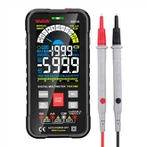
Infrared thermometer must be selected correctly
Infrared temperature measurement technology is playing an important role in product quality control and monitoring, equipment online fault diagnosis, safety protection and energy saving in my country. In the past two decades, non-contact infrared thermometers have developed rapidly in technology, their performance has been continuously improved, their scope of application has been continuously expanded, and their market share has increased year by year. Compared with the contact temperature measurement method, infrared temperature measurement has the advantages of fast response time, non-contact, safe use and long service life. Digital noise meters also play a certain role in measuring sound levels.
The working principle of the external thermometer:
Understanding the working principle, technical indicators, environmental working conditions, operation and maintenance of the out-of-group thermometer is to help users choose and use the infrared thermometer correctly.
All objects with a temperature higher than ** zero are constantly emitting infrared radiation energy to the surrounding space. The infrared radiation characteristics of an object—the magnitude of radiant energy and its distribution by wavelength—are closely related to its surface temperature. Therefore, by measuring the infrared energy radiated by the object itself, its surface temperature can be accurately determined, which is the objective basis on which infrared radiation temperature measurement is based.
Thermometer Blackbody Radiation Law:
A black body is an idealized radiator, which absorbs radiant energy of all wavelengths, has no reflection or transmission of energy, and has an emissivity of 1 on its surface. It should be pointed out that there is no real black body in nature, but in order to clarify and obtain the distribution law of infrared radiation, a suitable model must be selected in theoretical research. This is the quantized oscillator model of body cavity radiation proposed by Jintai Tech. The law of black body radiation of Jintai Scientific Instruments, that is, the spectral radiance of black body expressed in wavelength, is the starting point of all infrared radiation theories, so it is called the law of black body radiation.
The effect of thermometer object emissivity on radiation temperature measurement:
Almost all actual objects in nature are not black bodies. The amount of radiation of all actual objects depends not only on the wavelength of radiation and the temperature of the object, but also on the type of material that constitutes the object, the preparation method, the thermal process, and the surface state and environmental conditions. Therefore, in order for the law of black body radiation to apply to all practical objects, a proportionality factor related to the properties of the material and the state of the surface must be introduced, namely the emissivity. This coefficient represents how close the thermal radiation of an actual object is to that of a black body, and has a value between zero and a value less than 1. According to the law of radiation, as long as the emissivity of the material is known, the infrared radiation characteristics of any object can be known.
The main factors affecting the emissivity of infrared thermometers are:
Material type, surface roughness, physical and chemical structure and material thickness, etc.
When measuring the temperature of the target with an infrared radiation thermometer, the infrared radiation amount of the target in its band range should be measured first, and then the temperature of the measured target should be calculated by the thermometer. Monochromatic thermometers are proportional to the amount of radiation in the band: bicolor thermometers are proportional to the ratio of the radiation in the two bands.
Infrared thermometers must be correctly selected for the infrared system:
The infrared thermometer is composed of an optical system, a photodetector, a signal amplifier, signal processing, and display output. The optical system concentrates the infrared radiation energy of the target in its field of view, and the size of the field of view is determined by the optical parts of the thermometer and their positions. The infrared energy is focused on a photodetector and converted into a corresponding electrical signal. The signal is converted into the temperature value of the measured target after being corrected by the amplifier and signal processing circuit, and corrected according to the algorithm of the internal therapy of the instrument and the target emissivity.
The selection of infrared thermometers can be divided into three aspects:
Performance indicators, such as temperature range, spot size, working wavelength, measurement accuracy, response time, etc.; environment and working conditions, such as ambient temperature, window, display and output, protection accessories, etc.; other options, such as ease of use, maintenance And calibration performance and price, etc., also have a certain impact on the choice of thermometer. With technology and continuous development, the best designs and new advances in infrared thermometers provide users with a variety of functional and multi-purpose instruments, expanding the choice.
Determine the temperature range:
The temperature measurement range is one of the most important performance indicators of the thermometer. For example, the coverage range of JTCIN series products is -20℃-+2400℃, but this cannot be done by one type of infrared thermometer. Each model of thermometer has its own specific temperature range. Therefore, the user's measured temperature range must be considered accurate and comprehensive, neither too narrow nor too wide. According to the law of black body radiation, the change of radiant energy caused by temperature in the short waveband of the spectrum will exceed the change of radiant energy caused by the emissivity error.
Determine target size:
According to the principle, infrared thermometers can be divided into monochromatic thermometers and dual-color thermometers (radiation colorimetric thermometers). For a monochromatic thermometer, the area of the target to be measured should fill the field of view of the thermometer during temperature measurement. It is recommended that the size of the measured target exceed 50% of the field of view. If the size of the target is smaller than the field of view, the background radiant energy will enter the thermometer's audio-visual branch to interfere with the temperature measurement reading, resulting in errors. Conversely, if the target is larger than the thermometer's field of view, the thermometer will not be affected by the background outside the measurement area