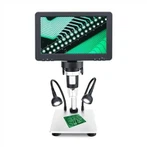
Installation method on universal tool microscope
Due to its various interchangeable lenses such as contour eyepieces and circular arc eyepieces, as well as accessories such as measuring knives and needle holders, the universal tool microscope is one of the commonly used instruments for length measurement. It can also measure length in the longitudinal, transverse, and even lead weight directions of the instrument. There are two installation methods for the tested object on the universal tool microscope:
1. Installation of flat measuring components
When measuring flat parts, it is important to note that the measured surface of the part should be on the same focal plane, otherwise it is easy to form local shadows. For parts with chamfers on the measured surface, it is best to make the chamfer face downwards, otherwise it may cause unclear focusing and inaccurate measurement.
2. Installation of axis measuring components
Axial measuring components generally rely on the center hole for positioning, so it is necessary to clean the * * hole thoroughly before installation, especially to eliminate any mud, sand, and burrs. Otherwise, the axis of the measured component may be different from the center line of the instrument, resulting in significant measurement errors* A good solution is to check the runout error of the outer diameter of the measured shaft with the horizontal line of the "meter" line in the instrument dividing board after installation, in order to determine whether the measured part is installed properly.
When measuring threaded parts, pay attention to the inclination direction of the column of the multimeter display
When measuring the thread pitch diameter and tooth half angle, in order to make the image clear, the column of the universal tool microscope is generally tilted to the left or right by a helix angle, and the tilt direction of the column should be consistent with the helix direction of the measured part. When the helix angle is large, it is easy to determine whether the inclination direction of the column is consistent with the helix direction of the workpiece by observing the clarity of the image. However, when the helix angle of the workpiece is less than 1 °, the impact on the image is small and difficult to judge with the naked eye. This often causes the inclination direction of the column to be opposite to the helix angle direction of the workpiece, resulting in inconsistent tooth profile half angles on the left and right sides of the measured workpiece, which poses great difficulties for workpiece processing. So before measurement, it is necessary to correctly determine the inclination direction of the column based on the spiral direction indicated in the workpiece drawing data.