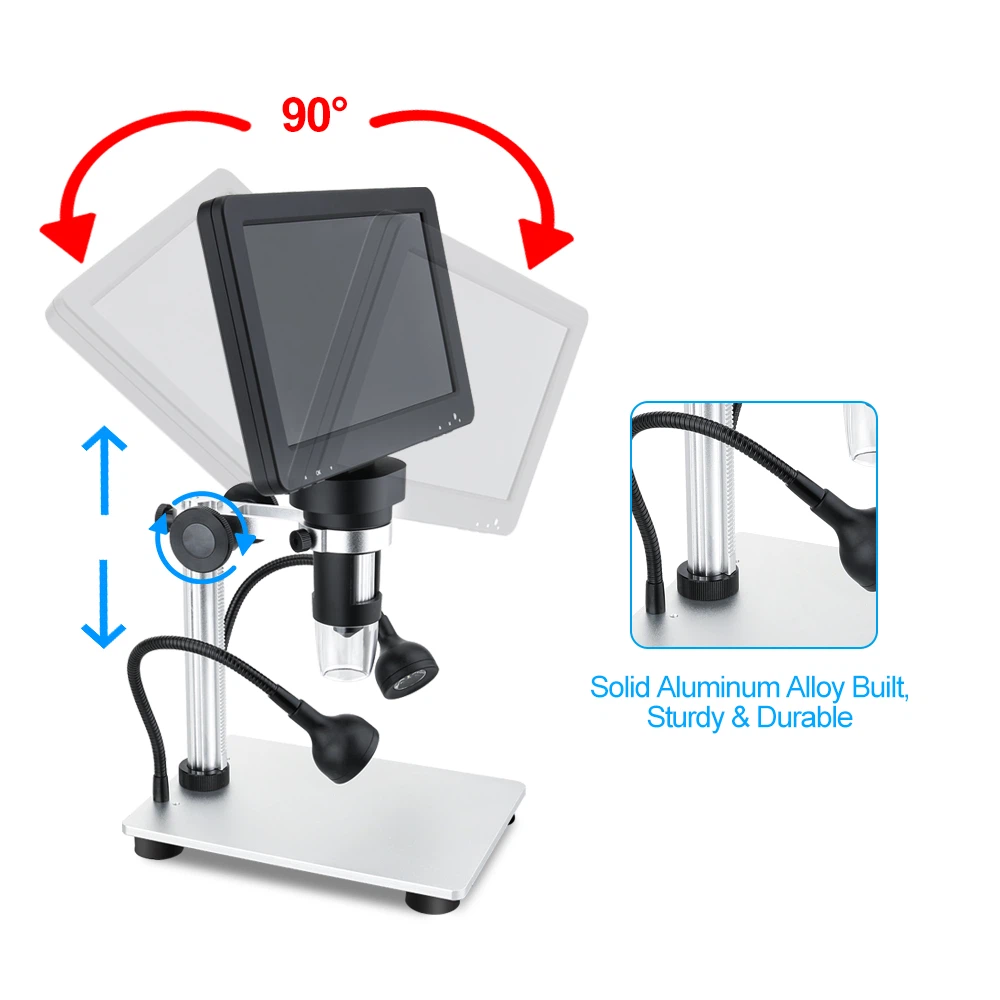
Instructions for the use of microscopes and their components
1. When using a single tube microscope, it is important to develop the habit of observing with the left eye. When observing, both eyes should be open at the same time, and one should not be closed, as this can lead to fatigue. In order to train students to be accustomed to having both eyes open for observation at the same time, a rectangular piece of hard paper about 14cm in length and 6cm in width can be cut. A circular hole with a diameter slightly smaller than the outer diameter of the upper end of the mirror tube can be dug near the left end, and the circular hole can be placed on the upper part of the mirror tube. When observing, both eyes should be opened at the same time, and the right end of the paper should be used to block the line of sight of the right eye. After a period of training, one can become accustomed to having both eyes open at the same time, and then remove the paper piece.
2. The connection between the arm and the base of a straight tube microscope is a mechanical joint that can be used to adjust the inclination of the tube for easy observation. The arm should not tilt too far back, generally not exceeding 40 °. However, when using temporary loading for observation, it is prohibited to use tilting joints (when the mirror tube is tilted, the stage also tilts, and the liquid on the slide is easy to flow out), especially when the loading contains acidic reagents to avoid damaging the mirror body.
3. Use of eyepieces and objective lenses
Usually, an eyepiece with a moderate magnification (10 ×) Start observing with the lowest magnification objective and gradually switch to a higher magnification objective to find the magnification that meets the experimental requirements.
When converting the objective lens, first observe with a low-power lens and adjust to the correct working distance (the clearest imaging). If a high-power objective is further used for observation, the part of the object that needs to be magnified for observation should be moved to the center of the field of view before switching to a high-power objective (when switching from a low-power objective to a high-power objective for observation, the range of the object in the field of view is much reduced). The low power objective and the high power objective are basically in focus (with the same height adjustment). When observing clearly with the low power objective, the object image should be visible when changing to the high power objective, but the object image may not be very clear and can be adjusted by rotating the fine focusing spiral.
It is generally believed that when using any objective lens, the upper limit of effective magnification is 1000 times its numerical aperture, and the lower limit is 250 times its numerical aperture. As in 40 × If the numerical aperture of the objective lens is 0.65, the upper and lower limits are respectively: 1000 × 0.65=650 times and 250 times × 0.65 ≈ 163 times, which exceeds the upper limit of effective magnification is called invalid amplification and cannot improve the observation effect. Magnification below the lower limit makes it difficult for the human eye to distinguish and is not conducive to observation. The most practical amplification range is generally between 500-700 times the numerical aperture.
4. The use of oil immersion lenses
When using oil immersion lenses, generally do not use the same height focusing. The same height focusing is only applicable to the original objective of each microscope, which is a very advantageous convenience when using low and high power objectives. However, when using oil immersed objectives, there are certain limitations. Generally speaking, when using oil immersed objectives to observe specimen slides (slides) without a cover glass, the degree of using the same height focusing is greater. However, for specimen slides with a cover glass, caution should be used because the working distance of oil immersed objectives is very short, The same height considered during design and assembly is for standard thickness cover glass slides.
When using an oil immersion objective, only apply tar to the specimen. After observation, it is necessary to carry out cleaning work in a timely manner. If not carried out in a timely manner, cedar oil may stick to dust, and dust particles may wear the lens during wiping. cedar oil may become thick and dry after being exposed to the air for a long time, making wiping difficult and detrimental to the instrument. Wipe carefully and gently. First, wipe the front end of the oil immersed objective once or twice with dry lens wiping paper, remove most of the oil, then wipe twice with xylene dripping lens wiping paper, and then wipe once with dry lens wiping paper. The cedar oil on the specimen slide can be wiped clean using the "paper pulling method" (that is, cover a small piece of wiping paper with cedar oil, then drop some xylene on the paper, and pull the paper out while it is wet. This method can be done three or four times continuously, and generally does not damage the specimen without the cover glass slide). Mirror wiping paper should also be dustproof. Generally, before use, cut each page into 8 small pieces and store them in a clean small petri dish, which is both economical and convenient to use.
5. How to use a condenser
① Reasons for using a condenser
When the magnification increases, on the one hand, the higher the magnification, the more lenses there are, and the more light absorbed by the lens; On the other hand, the brightness of the field of view (referring to the range of visible specimens) is inversely proportional to the square of the magnification, meaning that the higher the magnification, the darker the field of view. In order to obtain sufficient brightness, a condenser must be installed to concentrate the light on the specimen to be observed.
② The height at which the condenser should be placed during observation
When observing, it is necessary to ensure a good observation effect, and the focusing point of the condenser should fall exactly on the specimen. To achieve this condition, it is necessary to adjust the height of the condenser. When using directional light illumination, the focus of the condenser is about 1.25 mm above the center of its upper lens plane. Therefore, it is often required to raise the condenser to a height slightly lower than the platform plane during observation, so that the focus can fall on the specimen located on a standard thickness glass slide. When using a thinner than standard thickness slide to hold the specimen, the position of the condenser should be correspondingly lowered. However, when using a thicker slide, the focus of the condenser can only fall below the specimen, which is not conducive to precise observation.
③ Combination of condenser and objective lens
The so-called coordination here is to achieve consistency in the numerical aperture of the condenser and objective lens, in order to better conduct more detailed observations. If the numerical aperture of the condenser is lower than that of the objective lens, then some of the numerical aperture of the objective lens is wasted, and it cannot achieve its highest resolution. If the numerical aperture of the condenser is greater than the numerical aperture of the objective lens, on the one hand, it cannot improve the specified resolution of the objective lens, and on the other hand, it will decrease the clarity of the object image due to the too wide illumination beam. The operation method of combining the condenser with the objective lens is: after completing the illumination and focusing operations, remove the eyepiece and directly look into the lens barrel, close the variable aperture under the condenser to the minimum, and then slowly open it wider. Drive until its aperture is exactly the same as the diameter of the field of view you see, and then press the eyepiece to observe. Every time the objective lens is converted, it is necessary to perform this coordinated operation in sequence. Some concentrators have a scale engraved on the frame of the variable aperture indicating the opening aperture, which can be matched according to the scale.