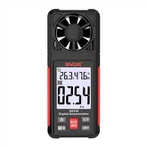
Instrumental wind speed How to use the instrumental anemometer and what are the maintenance precautions
The anemometer consists of three parabolic cones fixed at 120° to each other to form the sensing section. The concave sides of the empty cups all face one direction. How do we use it? What problems should you pay attention to during the maintenance of the instrument?
Instrument Anemometer
the
1. How to use an anemometer
the
1. Before using the meter, check whether the pointer of the meter points to zero. If there is a deviation, you can slightly adjust the mechanical adjustment screw of the meter to make the pointer zero.
2. Put the calibration switch in the off position.
3. Insert the plug of the measuring rod into the socket, place the measuring rod vertically upward, tighten the screw plug to seal the probe, and then perform the "correction" switch "full position. Slowly adjust the" full adjustment knob, and point the meter pointer to the full position.
4. Set the "calibration switch" to the "zero position", and slowly adjust the two knobs of "coarse adjustment" and "fine adjustment", so that the pointer of the ammeter points to the zero position.
5. After completing the above steps, gently pull the screw plug to expose the probe (the length can be selected according to the needs), so that the red dot on the probe faces the wind direction. Check the calibration curve against the meter reading to find the measured wind speed.
6. After measuring several points (about 10 minutes), the above steps 3 and 4 must be repeated to normalize the meter current.
Instrument Anemometer
2. Precautions for maintenance of anemometer
1. It is forbidden to use the anemometer in the environment of flammable gas.
2. Do not place the anemometer probe in flammable gas, otherwise it may cause fire or even explosion.
3. Please use the anemometer correctly according to the requirements of the instruction manual. Improper use may cause electric shock, fire and sensor damage.
4. In use, if the anemometer emits a peculiar smell, sound or smoke, or if liquid flows into the anemometer, please turn off the battery immediately. Otherwise, there is a risk of electric shock, fire and damage to the anemometer.
5. Do not expose the probe and anemometer body to the rain. Failure to do so may result in electric shock, fire and personal injury.
6. Do not touch the inner sensor part of the probe.
7. If the anemometer will not be used for a long time, please take out the built-in battery. Otherwise, the battery may leak and the anemometer may be damaged.
8. Do not place the anemometer in places with high temperature, high humidity, dust and direct sunlight. Failure to do so may result in damage to internal components or degradation of the anemometer performance.
9. Do not wipe the anemometer with volatile liquid. Failure to do so may cause deformation and discoloration of the anemometer case. When the surface of the anemometer is dirty, please wipe it with a soft cloth and mild detergent.
10. Do not drop or press the anemometer. Failure to do so will result in failure or damage to the anemometer.
11. When the anemometer is charging, please do not touch the sensor part of the probe. Otherwise it will affect the measurement results or cause damage to the internal circuit of the anemometer