Introduction and use of anemometer
Cup anemometer
It is the most common type of anemometer. The rotating cup anemometer was first invented by Robinson in England. At that time, there were four cups, and then three cups were used. The three parabolic or hemispherical empty cups fixed on the frame are all along one side, and the whole frame together with the wind cup is mounted on a shaft that can rotate freely. Under the action of wind force, the wind cup rotates around its axis, and its rotational speed is proportional to the wind speed. The speed can be recorded by electrical contacts, tachogenerators or photoelectric counters.
Propeller
It is an anemometer with a set of three or four bladed propellers rotating around a horizontal axis. The propeller is mounted on the front of a weather vane so that its plane of rotation is always facing the direction of the wind
Anemometer direction, its rotational speed is proportional to wind speed.
Hot Wire Anemometer
A metal wire heated by an electric current, the flowing air makes it dissipate heat, and the heat dissipation rate is linearly related to the square root of the wind speed, and then linearized by an electronic circuit (for easy calibration and reading), a hot wire anemometer can be made. There are two types of hot-wire anemometer: side heating type and direct heating type. The heating wire of side heating type is generally manganese copper wire, its temperature coefficient of resistance is close to zero, and a temperature measuring element is installed on its surface. The hot wire of the direct heating type is mostly platinum wire, which can directly measure the temperature of the hot wire itself while measuring the wind speed. The hot wire anemometer has high sensitivity at small wind speeds and is suitable for small wind speed measurements. With a time constant of only a few hundredths of a second, it is an important tool for atmospheric turbulence and agrometeorological measurements.
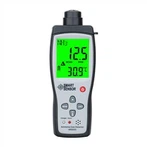
Digital Anemometer
The digital anemometer is a large-scale intelligent wind speed sensor and alarm device specially developed for various large-scale mechanical equipment. It uses an advanced digital anemometer inside
The advanced microprocessor is used as the control core, and the peripheral adopts advanced digital communication technology. The system has high stability, strong anti-interference ability, and high detection accuracy. The wind cup is made of special materials, with high mechanical strength and strong wind resistance. The display chassis is novel and unique in design, durable, and easy to install and use. All electrical interfaces conform to international standards, no debugging is required during installation, and it is suitable for different working environments.
The digital anemometer is used to measure the instantaneous wind speed and the average wind speed, and has functions such as automatic monitoring, real-time display, and over-limit alarm control.
Acoustic Anemometer
The wind speed component in the sound wave propagation direction will increase (or decrease) the sound wave propagation speed, and the acoustic anemometer made by using this characteristic can be used to measure the wind speed component. Acoustic anemometers have at least two pairs of sensing elements, each pair consisting of a sounder and a receiver. Make the propagation directions of the sound waves of the two sounders opposite. If one group of sound waves propagates along the wind speed component and the other group happens to travel against the wind, the time difference between the two receivers receiving the sound pulse will be proportional to the wind speed component. If two pairs of components are installed in the horizontal and vertical directions at the same time, the horizontal wind speed, wind direction and vertical wind speed can be calculated respectively. Because ultrasonic waves have the advantages of anti-interference and good directivity, the frequency of sound waves emitted by acoustic anemometers is mostly in the ultrasonic band.
Anemometer Application
Anemometers are widely used and can be used flexibly in all fields. They are widely used in electric power, steel, petrochemical, energy-saving and other industries. There are other applications in the Beijing Olympic Games, such as sailing competitions, rowing competitions, field shooting competitions, etc. Need to use an anemometer to measure. The anemometer has been relatively advanced, in addition to measuring the wind speed, it can also measure the wind temperature and air volume. There are many industries that need to use anemometers, recommended industries: fishing industry, various fan manufacturing industries, industries that require ventilation and exhaust systems, etc.
Anemometer Different seasons and different geographical conditions will cause the wind direction in the atmosphere to change constantly. For example, the wind direction of the seaside is different day and night, and there are different monsoons in winter and summer. Studying wind direction can help us predict and study climate change. Studying wind direction requires the use of an anemometer. The design of the anemometer is mostly in the shape of an arrow, but also in the shape of an animal, like a rooster. The fletch part of the anemometer will rotate with the wind direction. The anemometer needs to be installed in a place where there are no buildings or trees that obstruct the movement of the wind. Purpose and scope of application QDP series thermal bulb electric anemometer is used in heating, ventilation, air conditioning, meteorology, agriculture, refrigeration and drying, labor hygiene investigation, etc. It can be used when it is necessary to measure the airflow velocity indoors and outdoors or models. It is a basic instrument for measuring low wind speed. In 1987, the product was appraised as a famous product in Beijing by the Beijing Municipal Economic Commission. Working principle The instrument consists of two parts, a thermal bulb sensor and a measuring instrument. The head of the sensor has a tiny glass sphere with a nichrome wire coil that heats the glass and two thermocouples connected in series. The cold end of the thermocouple is connected to the phosphor bronze pillar and is directly exposed to the air flow. When a certain size of current passes through the heating coil, the glass ball is heated to a certain temperature. This temperature is related to the speed of the air flow, and the flow rate is small. The higher the temperature, the lower the temperature.