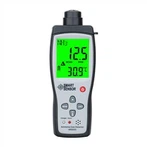
What does your anemometer look like?
Introduction to Tachymeter
An anemometer is an anemometer.
An anemometer is an instrument for measuring air velocity. There are many types of it, and the most commonly used one in meteorological stations is the wind cup anemometer. It consists of three parabolic cone empty cups fixed on the bracket at 120° to each other to form the sensing part. The concave surfaces of the empty cups are all in one direction. The whole induction part is installed on a vertical rotating shaft, and under the action of wind force, the wind cup rotates around the shaft at a speed proportional to the wind speed. Another rotary anemometer is the propeller anemometer, which consists of a three-blade or four-blade propeller as the sensing part, which is installed on the front end of a wind vane so that it is always aligned with the direction of the wind. The blades rotate around a horizontal axis at a speed proportional to the wind speed.
Anemometer use
1. Measure the velocity and direction of the average flow.
2. Measure the pulsation velocity of the incoming flow and its frequency spectrum.
3. Measure the Reynolds stress in turbulent flow and the velocity dependence and time dependence of two points.
4. Measuring wall shear stress (usually by using a hot film probe placed flush with the wall, the principle is similar to that of ** velocity measurement).
5. Measure the fluid temperature (measure the change curve of the probe resistance with the fluid temperature in advance, and then determine the temperature according to the measured probe resistance.
In addition, many professional uses have been developed.
How to use the anemometer
1. Before use, observe whether the pointer of the ammeter points to the zero point. If there is any deviation, you can gently adjust the mechanical adjustment screw of the ammeter to make the pointer return to the zero point;
2. Set the calibration switch to the off position
3. Insert the plug of the measuring rod into the socket, place the measuring rod vertically upward, press the screw plug tightly to seal the probe, put the "calibration switch" at the full position, slowly adjust the "full scale adjustment" knob, so that the pointer of the ammeter points to the full scale. degree position;
4. Put the "calibration switch" at the "zero position", slowly adjust the two knobs of "coarse adjustment" and "fine adjustment", so that the pointer of the ammeter points to the zero position
5. After the above steps, gently pull the screw plug to expose the probe of the measuring rod (the length can be selected according to the needs), and make the red point on the probe face the wind direction. According to the reading of the meter, check the calibration curve to find out Measured wind speed;
6. After measuring for several minutes (about 10 minutes), the above steps 3 and 4 must be repeated once to standardize the current in the meter
7. After the test, the "calibration switch" should be placed in the off position.