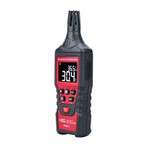
Introduction and Application of Anemometersnd theft
Wind cup anemometer
It is the most common type of anemometer. The rotary cup anemometer * was invented by Robinson in England as early as four cups at the time, but later changed to three cups. The three parabolic or hemispherical empty cups fixed on the rack are all aligned on one side, and the entire rack, along with the air cup, is mounted on a freely rotating shaft. Under the action of wind, the wind cup rotates around its axis, and its speed is proportional to the wind speed. The speed can be recorded using electrical contacts, tachogenerators, or optoelectronic counters.
Propeller type
It is an anemometer with a set of three or four bladed propellers rotating around the horizontal axis. The propeller is installed at the front of a wind vane, so that its rotating plane is always facing the wind
The direction of the anemometer is proportional to the wind speed.
Thermal anemometer
A metal wire heated by an electric current is dissipated by the flowing air. The heat dissipation rate is linearly related to the square root of the wind speed, and then linearized through an electronic circuit (for easy calibration and reading) to produce a thermal anemometer. There are two types of thermal wind speed scoring: side heating and direct heating. The thermal sensor of the side heating type is generally made of manganese copper wire, with a resistance temperature coefficient close to zero, and a temperature measuring element is installed on its surface. Directly heated * * is mostly made of platinum wire, which can directly measure the temperature of * * itself while measuring wind speed. The thermal anemometer has high sensitivity at low wind speeds and is suitable for measuring small wind speeds. Its time constant is only a few percent of a second, making it an important tool for atmospheric turbulence and agricultural meteorological measurements.
Digital anemometer
The digital anemometer is a large-scale intelligent wind speed sensing and alarm device developed specifically for various large mechanical equipment, which uses advanced digital anemometers internally
The microprocessor serves as the control core, and advanced digital communication technology is used on the periphery. The system has high stability, strong anti-interference ability, and high detection accuracy. The wind cup is made of special materials, with high mechanical strength and strong wind resistance. The display case design is novel and unique, sturdy and durable, and easy to install and use. All electrical interfaces comply with international standards and are debugging free during installation, suitable for different working environments.
The digital anemometer is used to measure instantaneous and average wind speeds, and has functions such as automatic monitoring, real-time display, and over limit alarm control.
Acoustic anemometer
The wind speed component in the direction of sound wave propagation will increase (or decrease) the speed of sound wave propagation, and acoustic anemometers made using this characteristic can be used to measure the wind speed component. The acoustic anemometer has at least two pairs of sensing elements, each pair including a sounder and a receiver. Make the sound waves of two sounders propagate in opposite directions. If one group of sound waves propagates along the wind speed component and the other group happens to propagate against the wind, the time difference between the two receivers receiving sound pulses will be proportional to the wind speed component. If two pairs of components are installed simultaneously in the horizontal and vertical directions, the horizontal wind speed, wind direction, and vertical wind speed can be calculated separately. Due to the advantages of anti-interference and good directionality of ultrasound, the frequency of sound waves emitted by acoustic anemometers is mostly in the ultrasonic band.