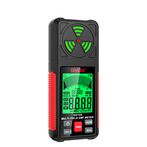
Introduction to the ranging principle of photoelectric rangefinder
The photoelectric ranging instrument can be divided into pulse ranging method for directly measuring time and phase ranging method for indirectly measuring time based on the method of measuring time t. High precision rangefinders generally use phase type.
The ranging principle of a phase type photoelectric rangefinder is that the light emitted by the light source passes through a modulator and becomes modulated light with varying intensity of high-frequency signals. Calculate the distance by measuring the phase difference (phi) of modulated light propagating back and forth over the measured distance.
The phase method distance measurement is equivalent to using a "light ruler" instead of a steel ruler to measure distance, and λ/2 is the length of the light ruler.
In a phase type rangefinder, the phase meter can only measure the tail number Δ N of the phase difference, and cannot measure the entire cycle number N. Therefore, it cannot measure distances greater than the optical ruler. To expand the measurement range, a longer ruler should be chosen. In order to solve the contradiction between expanding the measurement range and ensuring accuracy, two modulation frequencies, namely two types of optical rulers, are generally used on short-range rangefinders. For example, a long ruler (called a coarse ruler) f1=150kHz, λ1/2=1 000m, Used to expand the measurement range, measuring hundreds, tens, and meters; Short light ruler (referred to as precision ruler) f2=15MHz, λ2/2=10m, Used to ensure accuracy, measuring meters, decimeters, centimeters, and millimeters.
The ranging error of a photoelectric rangefinder is divided into two parts:
(1) Proportional error: an error proportional to the length of the measured distance, mainly caused by frequency error, atmospheric refractive index error, and vacuum light speed measurement error, resulting in errors in the ranging results. The influence of the measurement error of the speed of light on the ranging value can be ignored.
(2) Fixed error: The inherent error of an instrument, independent of the length of the measured distance, including calibration error of zero point error, alignment error between the instrument and the reflector, phase measurement error, amplitude and phase error, phase non-uniformity error of the light-emitting tube, and periodic error. The periodic error mainly comes from the same frequency interference of the internal photoelectric signal of the instrument, and the magnitude of the error is repeated in cycles of the length of the precision measuring ruler.