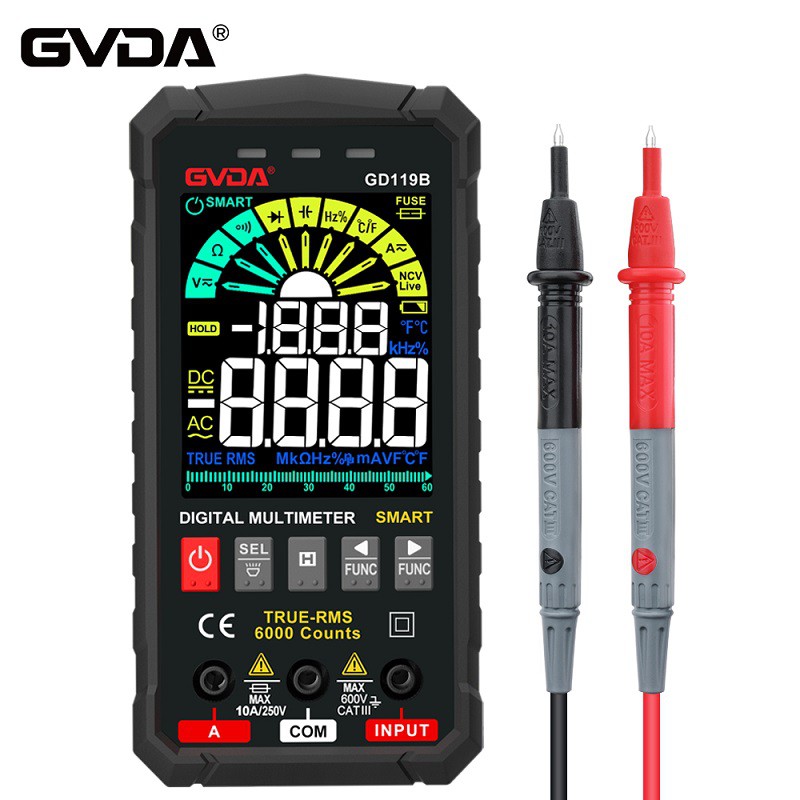
Introduction to the Usage Methods of Multimeter
(1) Before using a multimeter, it is necessary to perform a "mechanical zeroing", which means that when there is no measured power, the multimeter pointer should be placed at the zero voltage or zero current position.
(2) During the use of a multimeter, do not touch the metal part of the probe with your hands. This ensures accurate measurement and personal safety.
(3) When measuring a certain amount of electricity, it is not advisable to shift gears at the same time, especially when measuring high voltage or high current. Otherwise, it will damage the multimeter. If you need to shift gears, disconnect the probe first and then measure after shifting gears.
(4) When using a multimeter, it must be placed horizontally to avoid errors. At the same time, it is also important to avoid the influence of external magnetic fields on the multimeter.
(5) After using the multimeter, the conversion switch should be set to the maximum AC voltage setting. If not used for a long time, the battery inside the multimeter should be removed to prevent corrosion of other components inside the meter.
When using an analog multimeter, insert one end of each measuring probe into the measuring end according to the requirements of red to positive (+) and black to negative (-), and then confirm whether the pointer is in the "0" position. The pointer should be aligned with the end line on the left side of the dial. If it is not consistent, zero adjustment should be made. Before measuring current and voltage, it is necessary to estimate the range of the current and voltage to be measured, set it to a larger gear first, and then adjust it to the appropriate gear to avoid excessive current burning out the multimeter.
When measuring, the influence of the internal resistance of the multimeter should be considered. For example, in order to measure voltage, the probe needs to be connected to the circuit being tested. At this time, current also flows through the resistor in the multimeter, which has a certain impact on the measured value. When measuring the voltage at the same point, if different gears are used, the internal resistance of the multimeter will be different, and the degree of influence will also be different.
When measuring transistor electronic circuits, it is better to select an internal resistance of 20k Ω/V in DC mode, which is usually indicated on the multimeter dial. In addition, transistor circuits often need to measure low voltage values, such as 0.1V, and the selected multimeter should have a measurement range of 1V.