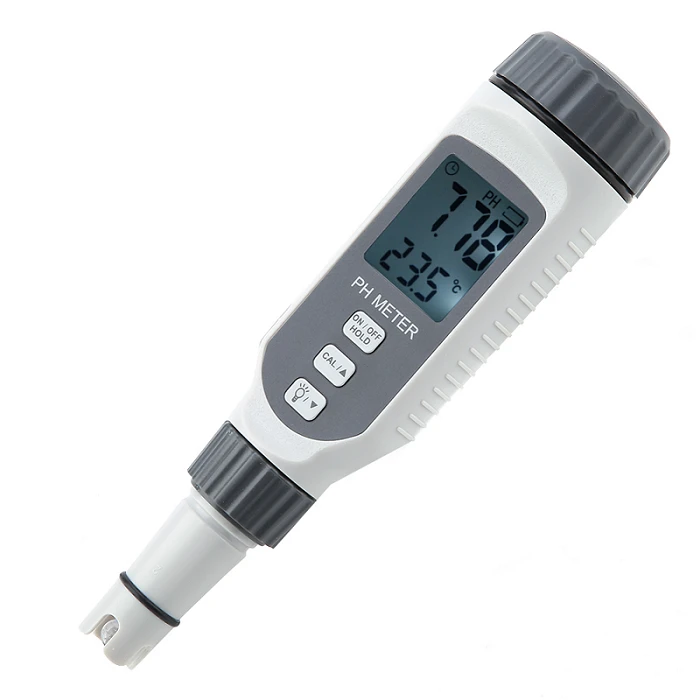
Issues that should be paid attention to when using a pH meter
Before proceeding, the integrity of the electrodes should be checked first. At present, most of the electrodes used on acidimeter (PH meter) are composite electrodes. The older generation of acidimeter still uses glass electrodes and calomel electrodes. Since composite electrodes are widely used, the following mainly discusses composite electrodes.
Calibrate the instrument according to the instrument instructions, and adjust the test solution and standard buffer solution to the same temperature. First insert the electrode into a standard buffer solution whose pH differs from that of the test sample by no more than two pH units, turn on the reading switch, adjust the positioner so that the reading is exactly the pH of the standard solution, and repeat several times to stabilize the reading. Take out the electrode, clean it, and then insert it into the first standard buffer solution. After the instrument is accurate, it can be used to measure the sample.
Main steps to use an acidometer:
1. Turn on the power switch to preheat.
2. Perform temperature compensation.
3. Use standard solution for positioning.
4. Use standard solution for slope correction.
5. Measure pH.
Precautions:
1. Newly used glass electrodes should be soaked in distilled water for 48 hours for activation before use.
2. The bulb part of the glass electrode has a very thin wall and should be protected even more during use.
3. The liquid to be tested should be at the same temperature as the standard buffer solution, otherwise temperature compensation and adjustment need to be performed again.
When replacing the solution to be measured, the electrode must be washed and dried.
The composite electrodes currently used in laboratories mainly include fully enclosed and non-enclosed types. There are relatively few fully enclosed electrodes, which are mainly produced by foreign companies. Before using the composite electrode, first check whether the glass bulb is cracked or broken. If not, when performing two-point calibration with a pH buffer solution, when both the positioning and slope buttons can be adjusted to the corresponding pH value, it is generally considered safe to use. Otherwise, press Use the instructions for electrode activation.
After the measurement is completed, the rubber should be restored and the small hole should be sealed. After the electrode is cleaned with distilled water, it should be soaked in 3mol/L potassium chloride solution to keep the electrode bulb moist. If the electrode is found to have lost the protective solution before use, it should be soaked in 3mol/L potassium chloride solution for several hours. , so that the electrode can achieve the best measurement state. In actual use, it was found that some analysts treat the composite electrode as a glass electrode and soak it in distilled water for a long time. This is incorrect. This will greatly reduce the concentration of potassium chloride solution in the composite electrode, resulting in The electrode response is insensitive during measurement, which ultimately leads to inaccurate measurement data. Therefore, the composite electrode should not be immersed in distilled water for a long time.