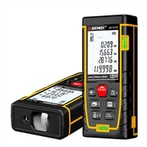
Key considerations for using a clamp ammeter in brief
A clamp meter (clamp meter) is a digital multimeter that combines an ammeter and a current transformer.
Its operation is similar to the current transformer used to measure current, making it an essential branch. A clamp meter combines an ammeter with a current transformer. When the wrench is tightened, the iron core of the current transformer can be opened, allowing the wire carrying the measured current to pass through the gap without being severed. When the wrench is loosened, the iron core closes.
The measured circuit wire that passes through the iron core transforms into the primary coil of the current transformer, and the passage of the current induces current in the secondary coil. Measure the current flowing through the line being tested so that the ammeter attached to the secondary coil can display a reading.
By altering the gear of the switch, the clamp meter can be set to different ranges. However, using electricity to change gears is not permitted. The accuracy of a clamp meter is often between 2.5 and 5, which is not very high. For ease of use, the meter has switches with various ranges that allow it to measure voltage and current at various current and voltage levels.
Originally intended to measure AC current, the clamp meter today does the same measurements as a multimeter, including AC and DC voltage, current, capacitance, diode, transistor, resistance, temperature, and frequency.
A clamp meter is a device that measures the amount of current flowing through an electrical circuit while the power is still being supplied. It is a piece of electrical equipment made specifically for measuring AC big current.
In Taiwan, the term "hook meter" is more common than "clamp ammeter."
The clamp ammeter is a handy test device that clamps the wire and measures the current without interrupting the circuit (also known as non-destructive measurement).
While the clamp ammeter just clamps on the sheath of the energized wire to detect current, analog pointer multimeters and digital multimeters also interrupt the circuit to do so. Large currents can be securely detected using this straightforward method even when the circuit is not connected directly.
Multimeters and insulation resistance meters come in two varieties: analog pointer and digital.
The standard type's detection range is between 2A and 200A or 400A for AC and DC, though there are some products that can detect high currents as high as 2000A;
Additionally, there are leakage detection tools that can pick up on several milliampere currents as well as the real effective value (True RMS) of non-sinusoidal waves other than sine waves, such as those produced by transformer and switching power supplies.
Clamp Meter Essentials
1: detection object
Choose the model according to different detection objects, AC current, DC current, or leakage current;
2: Detectable z largest conductor specification
To match the testing site, there are different specifications from 21mm diameter to 53mm diameter.
3: Is true value detection necessary?
The clamp ammeter using the average value mode cannot correctly detect the non-sinusoidal circuit of the motor and the circuit of the transformer. The clamp ammeter of the true effective value mode should be used to detect this circuit.
4: Other functions
Not only can detect the current, but also a model that integrates the detection function and record output.