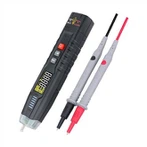
Key points of clamp Ammeter measurement
1. Safety requirements
1) In practical work, it is often necessary to measure the current value of low-voltage wires or equipment. In the measurement of the current of low-voltage bus and its electrical components in the power distribution device, the distance between the lines of low-voltage bus layout is generally not large enough. Some clamp Ammeter are large in size, and opening the jaw during measurement may cause interphase short circuit or grounding. If the measuring personnel's posture is unstable or their arms shake, accidents are more likely to occur.
Therefore, it is necessary to use qualified insulation materials to isolate the busbar and electrical components from each other based on the actual on-site conditions before measurement, while also taking care not to touch other live parts.
2) When measuring the current of bare wires, if the distance between different phase wires and between wires and ground is small, and if the insulation of the clamp is poor or the insulation sleeve is damaged, it is easy to cause short circuit accidents between phases and between phases and ground.
Therefore, it is generally stipulated that clamp Ammeter is not allowed to measure the current of bare conductor. If it is necessary to measure the current, safety preparations for insulation and isolation of bare conductor should be made to prevent accidents.
3) For multi-purpose clamp Ammeter, all functions shall not be used at the same time. For example, when measuring the current, the voltage cannot be measured at the same time. For safety reasons, the test line must be unplugged from the clamp Ammeter.
4) At the measurement site, all equipment should be in an orderly manner, and sufficient distance must be maintained between each part of the measuring personnel's body and the charged body, at least not less than the safe distance (the safe distance for low-voltage systems is 0.1m-0.3m). When reading, one often involuntarily lowers their head or approaches their waist, and special attention should be paid to the safe distance between the limbs, especially the head and the live parts.
2. Accuracy requirements
1) When measuring the current, the selection of the clamp Ammeter gear should be appropriate. It is best to make the needle fall on more than 1/3 of the scale. Because the deflection angle of the needle is too small, the scale value is difficult to distinguish, which affects the accuracy of measurement.
2) The measured wire should be placed at the center of the jaw as far as possible. If the measured wire is too slanted, the Magnetic flux density produced by the measured current on the iron core of the jaw will change significantly, which will directly affect the accuracy of the measurement. Generally, the measurement error caused by the improper position of the measured wire in the jaw can reach 2% -5%.
3) To ensure accurate readings, the two faces of the iron core pliers should be tightly closed. If you hear the electromagnetic noise from the jaw or feel a slight vibration of the hand holding the clamp Ammeter, it means that the end face of the jaw is not tightly connected. At this time, the jaw should be re opened and closed; If the noise still exists, the end face of the jaw should be checked for dirt or rust. If there is any, it should be cleaned until the jaw is well combined.
4) For the digital clamp Ammeter, although the battery power was checked before use, the battery power should also be paid attention to at all times during the measurement process. If the battery voltage is insufficient (such as the low voltage prompt symbol), the measurement must be continued after the battery is replaced; If there is electromagnetic interference at the measurement site, it will inevitably interfere with the normal operation of the measurement, so efforts should be made to eliminate the interference. Whether the measurement data can be read correctly also directly affects the accuracy of the measurement.
5) For the head of a pointer clamp watch, first identify the selected gear, and then identify which scale is used. When observing the scale value indicated by the watch needle, the eye should be facing the watch needle and scale to avoid strabismus and reduce parallax. Although the display of the digital meter head is relatively intuitive, the effective viewing angle of the LCD screen is very limited. It is easy to misread numbers when the eyes are too slanted. Attention should also be paid to the Decimal separator and its location, which should not be ignored.
6) Abnormal or drastic temperature changes in the measurement site will affect the accuracy of the measurement. Because changes in temperature can increase the error of the meter, thereby reducing its accuracy. The reason why the clamp Ammeter is affected by temperature is that the temperature change changes the material properties of the key structural parts of the instrument.
After changes in environmental temperature, the elasticity of the hairspring that often produces reaction torque in the instrument changes, resulting in changes in the instrument value. It can also change the magnetism of the permanent magnetic field that forms the magnetic field, causing changes in the magnitude of the action torque of the instrument.
In addition, due to changes in environmental temperature, the resistance of the circuits that make up the instrument, as well as the parameters of various electronic components and semiconductor devices, will change, and the final results will affect the accuracy of the measurement.
7) During the measurement process, it is not possible to clamp two or more wires simultaneously. When measuring currents below 5A, in order to obtain more accurate readings, if conditions permit, the wire can be wound several more times and placed in the clamp for measurement. However, the actual current value should be the reading divided by the number of wire turns placed in the clamp.